VCA Antech Reports Fourth Quarter 2008 Results and Provides Financial Guidance for 2009
* Fourth quarter revenue increased 6.7% to $303.2 million
* Fourth quarter gross profit increased 6.6% to $73.9 million
* Fourth quarter diluted earnings per share increased 3.4%
The report says this has been a hard year for them and they have not been able to sustain the growth of previous years. But with $73.9 million in profit on $303.2 millions in income, their profit margin is 24.4%!!
Imagine, 25% profit in a deep recession. AND, revenues were still up over the year before. Yes, the vet profession is suffering badly, isn't it?
The CEO also stated:
"Although our same-store revenue remained essentially flat during the quarter, our same-store gross profit margin increased to 18.3% compared to 16.2%." This purportedly was caused by cost cutting and each vet having more clients due to "consolidation of operations."
I don't doubt the cost cutting part, but the "expanded revenue base" probably means they are either charging more for each procedure, or performing more procedures for each patient, or both.
Also, they bought 8 vet operations out in the 4th quarter, with an average practice income of $4 million dollars.


Another 5th District Candidate Slams Boks

L.A. City Council candidate stands up for animals: “Ed Boks’ hiring was a mistake.”
by Kate Woodviolet,
Candidate David Vahedi is seen here with wife Karli and adopted rescue dogs Stofer and Jackson. It's unusual to get a straight answer from a politician, much less a candidate running for office. Sadly, it's even more unusual to find a politician who's willing to talk about a subject close to many people's hearts – the issue of animal care in our city.
That's why it was surprising that David Vahedi, candidate for City Council in the Fifth District, not only gave me time during his campaign to discuss several animal issues, but answered candidly my questions about frequently untouchable subjects, including the role of City government in animal welfare. He was blunt about some of L.A.’s failings.
Kate Woodviolet: Why do you make it a point to talk about animal issues?
David Vahedi: I think it’s the moral and right thing to do. KW: What, in your opinion, are the main problems facing animals in Los Angeles?
DV: There’s a lack of willingness [on the part] of Animal Services to do even the simplest things to avoid destroying animals. For example, the city still does not advertise in the Yellow Pages under pet stores. Many other examples exist, including LAPD’s unwillingness to take dog fighting on as a serious crime issue, [which also results in] many dogs released by gang members into the streets, un-neutered, when they do not fight.
I was surprised by the candor of Vahedi's response to questions regarding the failures of City government in the area of animal care and control.
KW: L.A. has two distinct governmental animal care and control entities: L.A. Animal Services for the city proper, which falls under the authority of the Mayor and the L.A. City Council; and the L.A. County Department of Animal Care and Control, for county and unincorporated areas, which is overseen by the County Board of Supervisors.
Both of these departments have experienced their share of controversy, including a recent petition of no confidence against LAAS General Manager Ed Boks signed by over fifty percent of LAAS workers; and several pending lawsuits against LACDACC and its director , Marcia Mayeda.
What, in your opinion, are the most pressing issues that need to be resolved, both with LAAS and LACDACC?
DV: Ed Boks’ hiring was a mistake. Own up to it and get him out. But problems also exist in management other than with Boks that must be addressed. I’m not as informed as I would like to be with LACDCC and as such I’ll reserve comment on that for now.
KW: As an L.A. resident, I see people walking dogs off-leash frequently, which is a violation of the law, and presents a danger to both dogs and humans. What would you do to strengthen leash laws and make sure they’re enforced?
DV: Similar to my proposal for graffiti and littering, mobile phone pictures can be uploaded to LAPDONLINE.ORG. If we know where [the owners] live, a citation can then be mailed.
But bottom line, I have seen LAPD units not on call drive by unleashed animals and not stop. We have to convince LAPD of the importance of enforcing leash laws.
Part 2: Vahedi is unsparing in his assessment of recent animal-related controversies including anti-Pit Bull legislation, and he gets honest with animal care activists.
Why Paul Koretz
For Los Angeles City Council District 5* on Tuesday March 3rd.
For Los Angeles City Council District 5* on Tuesday March 3rd.
Paul's Record:
.
West Hollywood (City Council 1988-2000)
*Created the City of West Hollywood Animal Issues Task Force
*Authored resolution declaring West Hollywood an animal cruelty-free city
*Authored ordinance preventing landlords from evicting seniors and the disabled for having small animals in their apartments
*Authored ordinance providing for a lower license fee for spayed or neutered animals
*Authored resolutions opposing cruel practices against animals, like the Draize test.
California State Assembly – 2000-2006
Most notable animal legislation included:
*AB 1857, which banned declawing of exotic and wild cats
*AB 1336, which was written to require all animals sold in pet stores to be spayed or neutered. It was amended to require pet stores to give out info. on the importance of spaying and neutering to all people purchasing animals
*ACR 143, a resolution declaring Spay Day in California
*SB1578, (principle co-author) banned dog-tethering
West Hollywood (City Council 1988-2000)
*Created the City of West Hollywood Animal Issues Task Force
*Authored resolution declaring West Hollywood an animal cruelty-free city
*Authored ordinance preventing landlords from evicting seniors and the disabled for having small animals in their apartments
*Authored ordinance providing for a lower license fee for spayed or neutered animals
*Authored resolutions opposing cruel practices against animals, like the Draize test.
California State Assembly – 2000-2006
Most notable animal legislation included:
*AB 1857, which banned declawing of exotic and wild cats
*AB 1336, which was written to require all animals sold in pet stores to be spayed or neutered. It was amended to require pet stores to give out info. on the importance of spaying and neutering to all people purchasing animals
*ACR 143, a resolution declaring Spay Day in California
*SB1578, (principle co-author) banned dog-tethering
New Commissioner Appointed,
Ruthanne Secunda
From the Internet:
Outside of her life as an agent, Secunda is heavily involved in the animal rescue community. She is a ten-year Board member of Much Love Animal Rescue, one of Los Angeles’ biggest, where she works in the rescue, rehabilitation and adoption of hundreds of animals yearly.
Secunda resides in Venice, CA.
More About Value Vet
I wanted to repeat some information that no one has commented on.
Value Vet WILL get the West Valley shelter spay/neuter contract unless they are stopped by LAAS staff or the Commission.
Because Barth and Boks have not made much of an effort to advertise the position, only Value Vet applied for the West Valley contract. Barth refused to entertain any further proposals from other vets because none but VV's was submitted by January 27.
Notice that the entities who have the current contracts are "friends of Boks," or at least well-known to Boks, namely Clinico (through Mary Martin from N.Y.), and Value Vet. I am afraid I am guilty here as I brought VV to Ed's attention two years ago. So, where is the outreach regarding the LAAS RFP for the S/N contract?
I will soon submit a malpractice complaint to the California Veterinary Medical Board re Value Vet. Perhaps this will help prevent their getting the contract.
No one from Value Vet has contacted me since my first post and public email. I did talk to the Canoga vet about a week before that first post. I complained about the charges. He offered me a $35 discount on a $2,270 bill to"make me happy." He was going to take off $100 off his surgery fee, but then add an additional $65 for dental, for a net refund of $35.
He never asked how Lakshmi was, nor did he apologize for her poor treatment. He did not acknowledge there was poor treatment.
He did not apologise for not force feeding her for four days, or for anything else. His sole concern with the amount on his bill. His name is Sherif Abdelmalak for future reference.
By the way, Lakshmi is doing well now. She is being treated by a great oncologist at West LA VCA, John Critine. She was given a single treatment of Cytoxin and a week later went on a combo treatment of Leukeran and Prednisone. She is also getting a formulated, beef flavored Flagyl and a probiotic for diarrhea. At times she acts like the 4 year old cat she is. He white blood count is down from 43,000 to 8,000 after a month of treatment.
I wanted to repeat some information that no one has commented on.
Value Vet WILL get the West Valley shelter spay/neuter contract unless they are stopped by LAAS staff or the Commission.
Because Barth and Boks have not made much of an effort to advertise the position, only Value Vet applied for the West Valley contract. Barth refused to entertain any further proposals from other vets because none but VV's was submitted by January 27.
Notice that the entities who have the current contracts are "friends of Boks," or at least well-known to Boks, namely Clinico (through Mary Martin from N.Y.), and Value Vet. I am afraid I am guilty here as I brought VV to Ed's attention two years ago. So, where is the outreach regarding the LAAS RFP for the S/N contract?
I will soon submit a malpractice complaint to the California Veterinary Medical Board re Value Vet. Perhaps this will help prevent their getting the contract.
No one from Value Vet has contacted me since my first post and public email. I did talk to the Canoga vet about a week before that first post. I complained about the charges. He offered me a $35 discount on a $2,270 bill to"make me happy." He was going to take off $100 off his surgery fee, but then add an additional $65 for dental, for a net refund of $35.
He never asked how Lakshmi was, nor did he apologize for her poor treatment. He did not acknowledge there was poor treatment.
He did not apologise for not force feeding her for four days, or for anything else. His sole concern with the amount on his bill. His name is Sherif Abdelmalak for future reference.
By the way, Lakshmi is doing well now. She is being treated by a great oncologist at West LA VCA, John Critine. She was given a single treatment of Cytoxin and a week later went on a combo treatment of Leukeran and Prednisone. She is also getting a formulated, beef flavored Flagyl and a probiotic for diarrhea. At times she acts like the 4 year old cat she is. He white blood count is down from 43,000 to 8,000 after a month of treatment.
BE MY FURRY VALENTINE ADOPTATHON
Reductions of more than 60% in adoption fees offered
Los Angeles – LA Animal Services, in partnership with the Found Animals Foundation and the Pet Care Foundation, is announcing the My Furry Valentine adoption event at all six Animal Care Centers.
Saturday and Sunday, February 14th and 15th
8 a.m. to 5 p.m. on Saturday and 11 a.m. to 5 p.m. on Sunday
Loving animals will be available for adoption at a Valentine’s Day special low price of $43 for a dog, $28 for a cat (second cat is free!) and $25 for a rabbit. This is a 60% to 80% savings off regular adoption fees. During this event, these low adoption fees include spay/neuter surgery, microchip, vaccinations and in the case of dogs a license.
On Saturday, Feb. 14th at the West LA and East Valley Care Centers, the My Furry Valentine event will include face painting, valentine-making and "Pet Matchmakers" to help you find your forever friend!
West Los Angeles Animal Care Center 11361 W. Pico Blvd. Los Angeles, CA 90064 Hours: 8am - 3pm
East Valley Animal Care Center14409 Vanowen Street Van Nuys, CA Hours: 8am - 3pm
Reductions of more than 60% in adoption fees offered
Los Angeles – LA Animal Services, in partnership with the Found Animals Foundation and the Pet Care Foundation, is announcing the My Furry Valentine adoption event at all six Animal Care Centers.
Saturday and Sunday, February 14th and 15th
8 a.m. to 5 p.m. on Saturday and 11 a.m. to 5 p.m. on Sunday
Loving animals will be available for adoption at a Valentine’s Day special low price of $43 for a dog, $28 for a cat (second cat is free!) and $25 for a rabbit. This is a 60% to 80% savings off regular adoption fees. During this event, these low adoption fees include spay/neuter surgery, microchip, vaccinations and in the case of dogs a license.
On Saturday, Feb. 14th at the West LA and East Valley Care Centers, the My Furry Valentine event will include face painting, valentine-making and "Pet Matchmakers" to help you find your forever friend!
West Los Angeles Animal Care Center 11361 W. Pico Blvd. Los Angeles, CA 90064 Hours: 8am - 3pm
East Valley Animal Care Center14409 Vanowen Street Van Nuys, CA Hours: 8am - 3pm
A Vet Responds to My Complaint About Value Vet
No animal on fluid therapy should be left alone for the following reasons:
Hydration status cannot be monitored and the animal can become overhydrated. This can be fatal. Especially for a cat.
The IV pump could alarm and stop (and usually does) meaning the patient will not receive the fluids it needs.
The patient can become restless and disconnect their IV line or pull out their IV catheter leaving an open port directly into their vein for bacteria.
Most vets will have signs posted stating that there is no night attendant on duty. I believe this is also required by law. Honest vets will tell you outright that your pet will not be monitored overnight and explain the risks stated above. They will also suggest that you take your pet to a 24 hour emergency facility for monitoring while on fluids. Further, they will have you sign an AMA if you refuse to transfer your pet. Less honest vets will withhold that information and continue charging you for hospitalization.
I have seen pets die in their cages overnight because they didn't get the fluids they needed.
Any cat not eating should be at least syringe fed to avoid hepatic lipidosis. If your cat was truly not given food for such extended periods, there had better be a legitimate reason why. It is otherwise malpractice.
There should be DVM notes for every day that she was there. If not, that is malpractice.
"N0 one had told him (The weekend vet) he should look at Lakshmi."
Oh, that's BAD! Total malpractice. He is personally responsible for every single patient in that hospital. In no way can he blame staff for his neglect.
"Lakshmi did not eat food when offered. My feeing was it was because of under-treated pain."
Very possible.
Dr. Abdelmalak said the three sets of X-rays were very difficult to read and understand because they showed poor organ definition.
Or because they were crap x-rays taken by crap staff with a crap machine. I would have to see them.
You have some very good and very pursuable points on how Lakshmi was neglected. I would stick with that. If you want VV investigated, you need to get a copy of your records and file a complaint with the VMB.
Hydration status cannot be monitored and the animal can become overhydrated. This can be fatal. Especially for a cat.
The IV pump could alarm and stop (and usually does) meaning the patient will not receive the fluids it needs.
The patient can become restless and disconnect their IV line or pull out their IV catheter leaving an open port directly into their vein for bacteria.
Most vets will have signs posted stating that there is no night attendant on duty. I believe this is also required by law. Honest vets will tell you outright that your pet will not be monitored overnight and explain the risks stated above. They will also suggest that you take your pet to a 24 hour emergency facility for monitoring while on fluids. Further, they will have you sign an AMA if you refuse to transfer your pet. Less honest vets will withhold that information and continue charging you for hospitalization.
I have seen pets die in their cages overnight because they didn't get the fluids they needed.
Any cat not eating should be at least syringe fed to avoid hepatic lipidosis. If your cat was truly not given food for such extended periods, there had better be a legitimate reason why. It is otherwise malpractice.
There should be DVM notes for every day that she was there. If not, that is malpractice.
"N0 one had told him (The weekend vet) he should look at Lakshmi."
Oh, that's BAD! Total malpractice. He is personally responsible for every single patient in that hospital. In no way can he blame staff for his neglect.
"Lakshmi did not eat food when offered. My feeing was it was because of under-treated pain."
Very possible.
Dr. Abdelmalak said the three sets of X-rays were very difficult to read and understand because they showed poor organ definition.
Or because they were crap x-rays taken by crap staff with a crap machine. I would have to see them.
You have some very good and very pursuable points on how Lakshmi was neglected. I would stick with that. If you want VV investigated, you need to get a copy of your records and file a complaint with the VMB.
Is a Value Vet Fix In?
Value Vet Fix In?
LAAS issued a near-secret RFP (Request for Proposals) in November regarding operating the West Valley spay/neuter clinic. The deadline for submitted proposals was January 27 of this year. There was a presentation meeting for anyone who wanted to learn the particulars about what was involved only 14 days after the proposal was out (November 19).
Guess who was the only vet group to submit a proposal????
VALUE VET!!
Is the fix in?
Who received notice of this RFP???
http://laanimalservices.org/PDF/rfp/clinics/Clinics%20RFP%20announcement%20letter-%20Nov%202008.pdf
I would assume with all vet business down there would be many vets interested in taking over a rent-free, utility-free facility, in the all new West Valley shelter.
So as the only bidder, will Value Vet be given another locked in private vet franchise for the West Valley? Will Value Vet be able to spay/neuter 7 of the City’s animals a day there, then be able to charge the public hundreds of dollars for a spay/neuter such as in West LA?
As it is, most every day someone brings in a sick or injured pet to the shelter and asks whether the shelter can do anything. Naturally, the shelter will say they have a vet on campus, in this case, Value Vet. So Value Vet gets all of this guaranteed, captured market.
How convenient.
In order for Boks to tell the Mayor and the Controller that five S/N clinics are up and running, he’ll make an agreement with a private vet clinic that appears ready, willing and able to both price fix and price gouge.
This cannot go through.
LAAS issued a near-secret RFP (Request for Proposals) in November regarding operating the West Valley spay/neuter clinic. The deadline for submitted proposals was January 27 of this year. There was a presentation meeting for anyone who wanted to learn the particulars about what was involved only 14 days after the proposal was out (November 19).
Guess who was the only vet group to submit a proposal????
VALUE VET!!
Is the fix in?
Who received notice of this RFP???
http://laanimalservices.org/PDF/rfp/clinics/Clinics%20RFP%20announcement%20letter-%20Nov%202008.pdf
I would assume with all vet business down there would be many vets interested in taking over a rent-free, utility-free facility, in the all new West Valley shelter.
So as the only bidder, will Value Vet be given another locked in private vet franchise for the West Valley? Will Value Vet be able to spay/neuter 7 of the City’s animals a day there, then be able to charge the public hundreds of dollars for a spay/neuter such as in West LA?
As it is, most every day someone brings in a sick or injured pet to the shelter and asks whether the shelter can do anything. Naturally, the shelter will say they have a vet on campus, in this case, Value Vet. So Value Vet gets all of this guaranteed, captured market.
How convenient.
In order for Boks to tell the Mayor and the Controller that five S/N clinics are up and running, he’ll make an agreement with a private vet clinic that appears ready, willing and able to both price fix and price gouge.
This cannot go through.
The Vet Care System is Broken--What to Do?
Have you gone to your vet lately? I have. Wherever I have gone, patronage is down. Their offices are mostly empty.
The same economic downturn that is causing pet owners to abandon their animals also has resulted in a marked decrease in vet care across the board.
There are a few clinics that still have business, like the West LA VCA with all its specialists. Wealthy people still take their pets to vets. Or poor people like me who have cats with cancer or other conditions requiring specialist consults. Then we go into debt we cannot afford.
The other vet offices that remain busy are those that do spay/neuter surgeries for City animals.
Rather than lowering fees to attract more business, some vets are offering extra services, and, it is alleged, providing unnecessary procedures to pad the bills of those who still take their animals for medical treatment. The Adler clinic in Reseda now offers house calls as well as boarding.
The same cost bloat that has plagued the human medical care system has impacted veterinary care for the last 15 years or so. An office visit costing $23.00 fifteen years ago, is now over $50. X-rays that used to be $65 ten years ago, now are $110. The Antech C1 blood panel that was an average of $106 three years ago is now $160 and counting.
When I worked at the old, pre-Cobb Value Vet in 1996 or so, the C1 panel cost $37.50 and we charged $105, about triple. This is where the money still lays, in diagnostic testing, X-rays, and medications.
Especially egregious back then were the charges for SQ fluids. Back in the 80s, one local vet charged $20 for a litre bag of Lactated Ringers, $7 for the IV line, and 50 cents for each needle. The charges have gone up since. Yet, Lactated Ringers solution NOW costs about $2.25 per bag at Costco, the IV lines cost $2.40 (for the best quality lines) on the Internet, and you can buy 100 Monoject 20 gauge needles for $8.00. The markups were and are 400 to 1,000%, far above the old retail and pre-1990 medical markup accepted rates of 300%.
Medications had and still do have similar mark ups.
Vets will be going through a difficult period for another year or two, but rather than dropping prices and advertising new, lower discount prices, they’d rather have an empty office, lay off staff and weather the drop in income.
How foolish.
An ambitious vet with some cash resources anticipating a two year dry spell, would cut prices significantly, and garner a larger percentage of the existing clients of other vets, plus create a new market out of those who stopped going to vets because of the cost. They would also try to capture new animal adopters form LAAS and County. This may be 30,000 40,000 potential clients a year. Then, when the economy turned up, they would have a far larger client base that will stay with them if they still provide good service at reasonable, if no longer, discount fees.
I don’t see this happening. Vet care as now provided is a broken system. Many veterinarian insurance carriers have a bad reputation for denied claims, and some have a criminal complaint past. There is no vetcare HMO yet. There is no Pet Medical Free Clinic—yet.
There are so many opportunities for change and improvement in the pet veterinarian field, but no one has stepped up to the plate.
Speaking of insurance, Boks is trying to get LAAS to advertise a pet medical insurance to new adopters for a rather trivial amount of income from that company. AND, who is it that has access to all of the Chameleon data in the department’s system? Avid of course. Petsmart? The Chameleon parent company? The new insurance carrier to be? This is a very, very valuable commodity for any retailer. Who gets this private information and at what price?
The same economic downturn that is causing pet owners to abandon their animals also has resulted in a marked decrease in vet care across the board.
There are a few clinics that still have business, like the West LA VCA with all its specialists. Wealthy people still take their pets to vets. Or poor people like me who have cats with cancer or other conditions requiring specialist consults. Then we go into debt we cannot afford.
The other vet offices that remain busy are those that do spay/neuter surgeries for City animals.
Rather than lowering fees to attract more business, some vets are offering extra services, and, it is alleged, providing unnecessary procedures to pad the bills of those who still take their animals for medical treatment. The Adler clinic in Reseda now offers house calls as well as boarding.
The same cost bloat that has plagued the human medical care system has impacted veterinary care for the last 15 years or so. An office visit costing $23.00 fifteen years ago, is now over $50. X-rays that used to be $65 ten years ago, now are $110. The Antech C1 blood panel that was an average of $106 three years ago is now $160 and counting.
When I worked at the old, pre-Cobb Value Vet in 1996 or so, the C1 panel cost $37.50 and we charged $105, about triple. This is where the money still lays, in diagnostic testing, X-rays, and medications.
Especially egregious back then were the charges for SQ fluids. Back in the 80s, one local vet charged $20 for a litre bag of Lactated Ringers, $7 for the IV line, and 50 cents for each needle. The charges have gone up since. Yet, Lactated Ringers solution NOW costs about $2.25 per bag at Costco, the IV lines cost $2.40 (for the best quality lines) on the Internet, and you can buy 100 Monoject 20 gauge needles for $8.00. The markups were and are 400 to 1,000%, far above the old retail and pre-1990 medical markup accepted rates of 300%.
Medications had and still do have similar mark ups.
Vets will be going through a difficult period for another year or two, but rather than dropping prices and advertising new, lower discount prices, they’d rather have an empty office, lay off staff and weather the drop in income.
How foolish.
An ambitious vet with some cash resources anticipating a two year dry spell, would cut prices significantly, and garner a larger percentage of the existing clients of other vets, plus create a new market out of those who stopped going to vets because of the cost. They would also try to capture new animal adopters form LAAS and County. This may be 30,000 40,000 potential clients a year. Then, when the economy turned up, they would have a far larger client base that will stay with them if they still provide good service at reasonable, if no longer, discount fees.
I don’t see this happening. Vet care as now provided is a broken system. Many veterinarian insurance carriers have a bad reputation for denied claims, and some have a criminal complaint past. There is no vetcare HMO yet. There is no Pet Medical Free Clinic—yet.
There are so many opportunities for change and improvement in the pet veterinarian field, but no one has stepped up to the plate.
Speaking of insurance, Boks is trying to get LAAS to advertise a pet medical insurance to new adopters for a rather trivial amount of income from that company. AND, who is it that has access to all of the Chameleon data in the department’s system? Avid of course. Petsmart? The Chameleon parent company? The new insurance carrier to be? This is a very, very valuable commodity for any retailer. Who gets this private information and at what price?
Value Vet CEO Misstates VV's Fees to the Public
According to the minutes of the August 25, 2008 Animal Services Commission meeting minutes,
http://laanimalservices.com/PDF/commission/2008/8_25_08%20Minutes.pdf
Ed McCobb, CEO of Value Vet addressed the concerns about their prices. They work with Pet Orphans Fund, who helps to pay for veterinary services for those who can not pay. Value Vet also offers low cost office visits and their costs in general are in the lower 25th percentile. Value Vet also works closely with rescue organizations and they have rescue organization pricing.
Really? The lower 25% of all veterinary service providers in the area?
Let’s take a look at what Value Vet charged me for Lakshmi’s care:
3 sets of X-rays at $110.00 each... $330.00
Feline Comprehensive
C1 blood test (Antech),...............$166.18
I.V. Fluids (lactated Ringers)
($2.25 a bag at Costco)...............$ 65.00
6 “Admin. of Meds”...................$300.00
Anesthesia, Isofluorane..............$100.00
Exploratory surgery
(45 minutes!!!).........................$500.00
Fecal Culture..........................$114.43
Fecal Combo/Giardia Test...........$ 51.00
Biopsy (Antech)........................$187.14
The total bill was.....................$2,170.00
They did charge on the low side for items like hospital stay, $30/day, initial exam, $30, and catheterization, $28.00, but the cost of prescribed meds was average to high average. For example, Cefa drops, 15ml was $28.00.
These charges certainly are not in the lower 25% of the prevailing rates in the West Valley. $500 for a 45 minute exploratorysurgery fee alone? That is $670/hour.
Now, I was told repeatedly that I was a preferred customer getting the best price break. What would Value Vet at Canoga Park charge for the average LAAS referred animal for spay/neuter surgery? How many “extra” services would they charge and at what rate?
More from the August 25 minutes:
Commissioner Riordan requested a price list for their other services and products. Mr. McCobb stated that that list was part of the proposal documents submitted. Commissioner Riordan expressed concern over Value Vet’s high prices for optional services to the public. Since such prices can be disapproved by the Department, she asked if Value Vet would lower the spay/neuter prices to the public. Mr. McCobb answered that he could not compete with his prices across the street at Value Vet’s private clinic.
Ms. Barth reminded the Commission that Value Vet would be doing all the shelter animals. Commissioner Riordan asked what the average daily adoption is at West Los Angeles. Ms. Barth stated the average would be around five a day. Commissioner Riordan clarified that after the five animals sterilized a day, Value Vet’s services will be for the public and it is required that those prices are for persons of all income levels.
(My comment): Value Vet gets to charge the public for general veterinarian services whatever it wants after performing 5 City animal spay/neuters a day. This is a good deal for Value Vet as they get totally rent free medical clinic facilities in a brand new shelter, free utilities, free cages and surgery table. Their only overhead is surgical equipment and salaries.
What does the City get?
It gets 5 spay/neuters a day, and 2% to 3% of the gross income for years 1 through three.
Let us just look at the spay/neuter fees the West LA Value Vet will charge:
Dog spay
Under 25 lbs...... $165.00
25 – 50 lbs......... $175.00
51 – 75 lbs......... $200.00
Over 75 lbs........ $280.00
Dog neuter
Under 25 lbs...... $150.00
25 – 50 lbs......... $160.00
51 – 75 lbs......... $175.00
Over 75 lbs........ $240.00
Cat spay........... $135.00
Cat neuter........ $ 90.00
Since outside contract vets are accepting City $68 vouchers for many S/N surgeries, is the cat spay price of $135 of benefit to the public? What about the large dog spay price of $280 or neuter of $240?
Compare these prices to the $25 to $55 fee for all dog and cat spay/neuters charged to the general public by Clinico.
AND, as Commissioner Riordan asked, what is Value Vet’s pricing for all their other general veterinary services? Do you think Ed Cobb will mention the $670/hour exploratory surgery rate? Recently I priced a general vet in the Northridge area re exploratory surgery charges: $440/hour ($110/15 minutes).
I might mention when I complained to the vet who did the surgery, he bragged he had charged someone the day before $800.00 for exploratory surgery.
In summary, the Value has gone out of Value Vet since it won a City contract. Ed Cobb stated a mistruth, to say the least, that Value Vet’s prices are in the lower 25% of the area prevailing.
Is anyone at the City monitoring their vet contractors’ charges, performance and complaints? What is the bad surgery and mortality rates for these contractors? How many extra services are they charging for and at what rate? Is there a mechanism by which the public can file a complaint against outside contractors like Porter Pet hospital, or on site contractors like Value Vet or Clinico?
I would remind you that the West Valley facility is miniscule and dangerously chaotic for the volume of S/N surgeries it performs on weekends, so chaotic that Lakshmi had very poor care and monitoring for four days of hospitalization. Will this be the case at the West LA City shelter site too?
http://laanimalservices.com/PDF/commission/2008/8_25_08%20Minutes.pdf
Ed McCobb, CEO of Value Vet addressed the concerns about their prices. They work with Pet Orphans Fund, who helps to pay for veterinary services for those who can not pay. Value Vet also offers low cost office visits and their costs in general are in the lower 25th percentile. Value Vet also works closely with rescue organizations and they have rescue organization pricing.
Really? The lower 25% of all veterinary service providers in the area?
Let’s take a look at what Value Vet charged me for Lakshmi’s care:
3 sets of X-rays at $110.00 each... $330.00
Feline Comprehensive
C1 blood test (Antech),...............$166.18
I.V. Fluids (lactated Ringers)
($2.25 a bag at Costco)...............$ 65.00
6 “Admin. of Meds”...................$300.00
Anesthesia, Isofluorane..............$100.00
Exploratory surgery
(45 minutes!!!).........................$500.00
Fecal Culture..........................$114.43
Fecal Combo/Giardia Test...........$ 51.00
Biopsy (Antech)........................$187.14
The total bill was.....................$2,170.00
They did charge on the low side for items like hospital stay, $30/day, initial exam, $30, and catheterization, $28.00, but the cost of prescribed meds was average to high average. For example, Cefa drops, 15ml was $28.00.
These charges certainly are not in the lower 25% of the prevailing rates in the West Valley. $500 for a 45 minute exploratorysurgery fee alone? That is $670/hour.
Now, I was told repeatedly that I was a preferred customer getting the best price break. What would Value Vet at Canoga Park charge for the average LAAS referred animal for spay/neuter surgery? How many “extra” services would they charge and at what rate?
More from the August 25 minutes:
Commissioner Riordan requested a price list for their other services and products. Mr. McCobb stated that that list was part of the proposal documents submitted. Commissioner Riordan expressed concern over Value Vet’s high prices for optional services to the public. Since such prices can be disapproved by the Department, she asked if Value Vet would lower the spay/neuter prices to the public. Mr. McCobb answered that he could not compete with his prices across the street at Value Vet’s private clinic.
Ms. Barth reminded the Commission that Value Vet would be doing all the shelter animals. Commissioner Riordan asked what the average daily adoption is at West Los Angeles. Ms. Barth stated the average would be around five a day. Commissioner Riordan clarified that after the five animals sterilized a day, Value Vet’s services will be for the public and it is required that those prices are for persons of all income levels.
(My comment): Value Vet gets to charge the public for general veterinarian services whatever it wants after performing 5 City animal spay/neuters a day. This is a good deal for Value Vet as they get totally rent free medical clinic facilities in a brand new shelter, free utilities, free cages and surgery table. Their only overhead is surgical equipment and salaries.
What does the City get?
It gets 5 spay/neuters a day, and 2% to 3% of the gross income for years 1 through three.
Let us just look at the spay/neuter fees the West LA Value Vet will charge:
Dog spay
Under 25 lbs...... $165.00
25 – 50 lbs......... $175.00
51 – 75 lbs......... $200.00
Over 75 lbs........ $280.00
Dog neuter
Under 25 lbs...... $150.00
25 – 50 lbs......... $160.00
51 – 75 lbs......... $175.00
Over 75 lbs........ $240.00
Cat spay........... $135.00
Cat neuter........ $ 90.00
Since outside contract vets are accepting City $68 vouchers for many S/N surgeries, is the cat spay price of $135 of benefit to the public? What about the large dog spay price of $280 or neuter of $240?
Compare these prices to the $25 to $55 fee for all dog and cat spay/neuters charged to the general public by Clinico.
AND, as Commissioner Riordan asked, what is Value Vet’s pricing for all their other general veterinary services? Do you think Ed Cobb will mention the $670/hour exploratory surgery rate? Recently I priced a general vet in the Northridge area re exploratory surgery charges: $440/hour ($110/15 minutes).
I might mention when I complained to the vet who did the surgery, he bragged he had charged someone the day before $800.00 for exploratory surgery.
In summary, the Value has gone out of Value Vet since it won a City contract. Ed Cobb stated a mistruth, to say the least, that Value Vet’s prices are in the lower 25% of the area prevailing.
Is anyone at the City monitoring their vet contractors’ charges, performance and complaints? What is the bad surgery and mortality rates for these contractors? How many extra services are they charging for and at what rate? Is there a mechanism by which the public can file a complaint against outside contractors like Porter Pet hospital, or on site contractors like Value Vet or Clinico?
I would remind you that the West Valley facility is miniscule and dangerously chaotic for the volume of S/N surgeries it performs on weekends, so chaotic that Lakshmi had very poor care and monitoring for four days of hospitalization. Will this be the case at the West LA City shelter site too?
AVOID VALUE VET!!
Remember how supportive I have been of Value Vet in the past and supported the City award of the S/N contract for West LA?
Boy, was I mistaken. Since they are now a major contractor of vet services at their three sites, they have decided to upscale their fees big time. Yet in the West Valley, their facilities and staff are so small, they cannot safely support the services they are offering.
Value Vet is now providing Third World Veterinarian Services at VCA prices.
Remember too how I said I rescued this little old cat off the street--Lakshmi? Well, this is her and my story.
The Below was sent to the Animal Services Commissioners:
Dear Commissioners
Ed Boks
Linda Barth
Dr. Jeremy Prupas
Many of you know I have championed Value Vet during the past three years as an excellent provider of veterinarian services, including the Department awarding it the West LA spay/neuter contract against some opposition.
I first went to Value Vet three or four years ago where I met Dr. Feldman, who was always gracious, had a great bedside manner and provided quality veterinarian care at a budget price. In my estimation Dr. Feldman provided care at about a 30+% discount compared to other vets in the West Valley area.
However, things have changed. Since the City awarded Value Vet the West LA spay neuter contract, and since VV performs a large number of spay/neuter surgeries, VV now has a large, City-sponsored and supplied captive audience.
It appears that Value Vet is taking advantage of this City captive market and has moved from supplying excellent care at a discount, to providing ever more ambitious care at a much higher prevailing fee rate, however, without the staff to safely supply these procedures.
My recent experience with the Canoga VV has been a nightmare, with a rescue cat receiving a 45 minute abdominal exploratory surgery on Friday afternoon, and being left unattended, while receiving fluids on an IV drip for four days, sometimes being unsupervised, unmonitored and unfed for up to 19 hours at a time. She was not given pain medications on the second day. None of the two weekend veterinarians was asked to look at her to see how she was doing. She did not eat for 4 days, yet no one attempted to syringe feed her.
I have asked around for professional opinions and universally they say no cat having received major surgery and while on an IV drip should be left alone beginning three hours later, for 15 hours until the morning staff came in. The next day she was left alone at night, unmonitored for 16 hours, and Sunday evening for 19+ hours. This is not an acceptable level of care for an animal having received major surgery.
My experience in summary:
The fees at Value Vet are no longer a value as in the past. For all intents and purposes their charges are the same as those at VCA or other large multivet clinics that have huge overhead in terms of large facilities, large numbers of very expensive diagnostic and treatment equipment, large staffs, near round the clock veterinarians on duty, as well as night vet tech staff.
The Canoga Value Vet does not have a round-the-clock staff to monitor animals overnight and the physical plant itself is miniscule and chaotic with huge potential for medical mistakes.
My cat Lakshmi spent a total of 5 days during two hospitalizations, including 4 after major surgery, on an IV fluid drip without a night staff to monitor her health. Why I allowed this I do not know. I put her life at risk by letting her be without medical supervision for as many as 19 hours at a time. The surgery was Friday afternoon, and the clinic closed at 6 pm, leaving her alone until 9 am Saturday morning, and then again from 2 pm on Sunday to 9:00 on Monday morning.
The total cost of treatment was essentially the same as if I had taken her to a specialist, given a far less intrusive endoscopy with biopsy, rather than the long abdominal exploratory surgery she did have, followed by 4 days and nights on an IV, totally alone at night. Yet, I was told since I had such a long relationship with VV and they had treated several pets in the past, I was given their top, lowest priced, best discount. This leads me to ask how much are they charging to the general public who now comes mostly as a City referral?
On the weekend, she was locked in a single bank of cages, next to very noisy cages with lots of frightened dogs kep before and after S/N surgery of animals referred by LAAS. The room where she was caged is also the surgery prep room, is incredibly small (maybe 80 sq ft) and therefore very crowded with the cages, the animal preparation area, people going in and out of the bathroom, or in and out of surgery attached to that same room carrying comatose animals to cages. On week ends, due to all the business the City of Los Angles sends their way, there are many spay/neuter surgeries and the animals recover or await surgery in the same bank of cages she was in. That little room is chaotic and rife with the possibility of medical treatment error.
Lakshmi was never looked at by a weekend (Saturday and Sunday) relief vet until I insisted on Sunday. The vet with a Russian sounding name told me on Sunday (the surgery was Friday afternoon) no one had told him he should look at Lakshmi, the only cat that was there when he arrived, and who had been there in a cage, on an I.V., for two days following major surgery. Why he had not been asked to check on her condition as part of his duties on Sunday points to some sort of communication problem within the clinic.
Dr. Sherif Abdelmalak did not see Lakshmi until Monday morning, 2-1/2 days after the surgery, despite my telling staff on Sunday that Lakshmi was not doing well. She had not eaten since surgery on Friday. She subsequently vomited 4 different places in her cage between 2 pm on Sunday and 10 am Monday morning.
When I came on Sunday to see her, they were already closing up early (2 pm) and I found to my utter shock and depression that Lakshmi had not had any pain medication that day---the second day after major surgery. I finally demanded she be given pain medication.
I was told by staff that Dr. Abdelmalak had stated pain meds were only to be given on Saturday, because the pain meds could mask her symptoms. But so what? No vet looked at her on the weekend, and she would be alone in the cage for an additional 19 hours from Sunday at 2 pm to Monday at 9 am. What good did it do for her to be in pain, alone for over 19 hours so that no one could see whatever symptoms she was having, and Abdelmalak didn’t think not eating for 2 days and frequent vomiting was worth a visit by him.
In fact, on Saturday I saw the note on her cage that said she was to be given pain medication on Saturday only. I asked Tony (office manager) if the pain meds were only going to be given on Saturday as the note said, and why none were prescribed for Sunday. Tony said that those notes were for Saturday only, and certainly she would be given pain medications on Sunday and Monday. But they did not until I insisted on Sunday as they were closing. Rather than give Buprinex 2 X a day, it was given only once every 24 hours.
Dr. Abdelmalak was told by staff at my insistence at about 2 pm that she was not doing well. He made no attempt to come in and see her. He said there was nothing he could do but wait.
Lakshmi did not eat at all from the time of her surgery until I picked her up on Tuesday—4 days. Dr. Abdelmalak insisted she only be fed Science Diet i/d for abdominal symptoms. She did not touch i/d for 4 days. Apparently he thought it better for her not to eat at all than to eat anything besides Science Diet i/d.
Dr. Abdelmalak only once talked to me on the phone during the 4 days Lakshmi was in the hospital despite his promise to advise me of lab results and her progress. He talked to me that one time on the phone when I was in tears demanding she get pain medication on Sunday afternoon, and after I complained to staff that Dr. Abdelmalak never talks to me on the phone—he has others do it. Communication was never initiated by Value Vet. Never. Of course I did talk to him when I came in on Monday.
Later when I talked to him he told me his father had had a heart attack
That weekend and his personal life was in chaos. I can understand his viewpoint, but, at the same time, my cat’s life was in danger, she had no pain meds, she was not eating, and no attempt was made to syringe feed her. And, the weekend vets were not even told to look at her.
Value Vet closed at 2 p.m. on Sunday. She had not been eating so they left a small dab of Science Diet i/d on a small plate as her only food. On Monday morning, I waited until 10:15 a.m. to call to see if she had been eating. I had assumed they would have tried to feed her first thing since she had nothing fresh for 19 hours. Incredibly, Tony said they had not fed her yet, but they would “In about 15 minutes.” She went 20.5 hour without food.
On Monday afternoon I suggested feeding her something other than i/d, such as a/d, which she had eaten before. Lakshmi did not eat this either when offered. My feeing was it was because of under-treated pain.
Tuesday morning when I came to see her she had still not eaten. They had not tried any other food. It is my understanding that if a cat has not eaten in two or three days, it is better to get her to eat anything rather than just the “correct” prescription food. Dr. Abdelmalak stated he thought it better she remain the another day, as though she was not eating, she was still getting fluids and medication. I said no, I wanted to take her home. I had brought a can of Fancy Feast with me. Lakshmi wolfed down a half can in 15 seconds. I did not feed her any more at that time, but made arrangements to take her home several hours later when it was less busy. Tony and the doctor were both surprised and happy that she was finally eating.
Dr. Abdelmalak said the three sets of X-rays were very difficult to read and understand because they showed poor organ definition. He stated that the poor definition may be due to the presence of abdominal fluids or rampant inflammation in her belly. He did state he did not think it was fluid after palpation.
The oncologist I took Lakshmi to at VCA on January 8 (Dr. John Critin) stated the X rays were of relatively poor quality but clearly showed multiple organ enlargement, spleen, liver but especially stomach. He stated that Dr. Abdelmalak should have told me this. However, it was clear that Dr. Abdelmalak did not know this at all. He was perplexed by the results. Critin also said her heart was small and she had a heart murmur. Dr. Abdelmalak did not mention this either.
Regarding Lakshmi’s cost of treatment. When I first brought her in, a week before the surgery, Abdelmalak said because I was a long time customer, had been supportive of Value Vet and knew Dr. Feldman, I would get the highest discount, their very best prices. Instead:
Regarding prices, I believe 6 “administrations of meds” (over the 2 admissions) charged at $300.00 was excessive.
The Antech C1 blood panel was charged at $166.18, high average. VCA charged $165 and change.
The Fecal Combo Giardia test was $51.00, I think high normal prevailing rate. Fluids were $65, the same as VCA. Catheterization was $28, $20 less than VCA, and the office vistit was $20 less than VCA.
Additional Urinalysis was an additional $25.88, again, slightly lower than VCA.
The $500.00 charged for exploratory surgery was excessive in that I could have taken her to my own internal med specialist I’ve used before (Dr. Broome) for a far less invasive and painful endoscopy for $425.00. Biopsy, of course, was necessary in both cases. Dr. Abdelmalak never suggested referral to someone else for less invasive treatment, nor to defer surgery until after the weekend, when he would be the attending, or to take her to another clinic with a night staff. He did suggest I could take her to an emergency clinic after surgery so someone could monitor her at night if that made me more comfortable. However, that would have cost hundreds more. Apparently he did not think leaving her alone for 15-16 hours (Friday closing to Saturday opening) was a concern.
It was a concern of mine at the time, but the concern became extreme after I saw with my own eyes how she had been treated.
I was given an estimate for the exploratory surgery procedure and dental (we talked about the extraction of one tooth beforehand), and was shocked to hear an estimate of over $1,400. This was in addition to the well over $700 I had already spent. She was already in the back room being prepped and I had no idea if I could get her to see my usual internal med specialist (Dr. Broome) in Westwood in a reasonable time as an alternative. I did not know how sick she was so I thought immediate treatment was essential and gave in---extremely reluctantly. I found out later that Dr. Broome was out of town until the following Wednesday and I didn’t see much use in taking her to another general vet like Adler, which would have required an entirely separate workup and perhaps redundant testing, although Reimer may have been less aggressive or suggested an endoscopy. Nor did I know whether Reimer was available or what other doctor might be on call. Lastly, I had had 3 cats die while hospitalized at Reimer’s clinic in the previous 18 months, so I was not in a rush to take any other cat there. (Two kidney failures on fluids and one cat with exploratory surgery and cancer tumor removal.)
I asked Tony if I could get a discount, and Dr. Abdelmalak told him that this ridiculous charge already had a razor sharp profit margin, but he did give me a 5% discount.
After the exploratory of her belly, while she was still under, I was talking to Tony and he said Dr. Abdelmalak said she needed a dental and extraction, which would cost another $65, even though we had already discussed the dental need this prior to the estimate. I had assumed the dental was included in the quote. Of course I said yes. He also said a fecal culture was needed and that was another $114. I felt he had misinformed me with a lowball estimate or else he should have been more careful in preparing it and added in the dental. I learned afterwards that Tony may not have put the dental charge on the final bill. I am awaiting copies of all the bills as mine appear different from what the doctor said I was changed.
I feel I was given first world charges for what turned out, in my opinion to be third world care, with no night supervision for as many as 19 hours at a time while she was on an I.V., and no pains meds after Saturday until I insisted. I was deeply hurt, depressed and feeling guilty by what I put Lakshmi through as well as feeling I had made a fool of myself for going along with Dr. Abdelmalak’s treatment plan of exploratory surgery. I just did not know how sick she was, if I could see a specialist in a short period, she was already being prepped for surgery. I felt under pressure to make an immediate choice and chose for treatment despite misgivings as Dr. Abdelmalak indicated it was a medical necessity. Who am I to judge medical necessity? I still feel depressed and guilty almost two weeks after the surgery.
Given the extremely small size and layout of the Canoga facility, and given the volume of City-referred and funded surgeries taking place there, I fear for the quality of the care offered to these animals, and I wonder what is the final out the door charges are to new owners who are given essentially a free spay/neuter, but may end up paying substantially more.
If the bill I received and the care Lakshmi received was their premium best for a long-time customer, what is happening with the general public?
I think the Commission has to do due diligence in this situation as Value Vet is a City contractor, and investigate the Canoga premises as to the adequacy of the facility for high volume care of City adopted animals, and which treatment will reflect on the City with VV as a contractor.
I think the City should obtain a sample of the final bills given to adopters to check the fees and procedures.
I think VV should never be allowed to do a major surgery leaving an animal alone at night after major surgery, and especially while on IV fluids.
The biggest question in my mind is how could Value Vet go from being a good, solid discount veterinary providing quality services at substantially below market prices, until they get a City S/N contract, a rent free state of the art facility, along with no utility payment overhead, and then go to a VCA level of pricing offering services beyond their capacity to provide safely?
Boy, was I mistaken. Since they are now a major contractor of vet services at their three sites, they have decided to upscale their fees big time. Yet in the West Valley, their facilities and staff are so small, they cannot safely support the services they are offering.
Value Vet is now providing Third World Veterinarian Services at VCA prices.
Remember too how I said I rescued this little old cat off the street--Lakshmi? Well, this is her and my story.
The Below was sent to the Animal Services Commissioners:
Dear Commissioners
Ed Boks
Linda Barth
Dr. Jeremy Prupas
Many of you know I have championed Value Vet during the past three years as an excellent provider of veterinarian services, including the Department awarding it the West LA spay/neuter contract against some opposition.
I first went to Value Vet three or four years ago where I met Dr. Feldman, who was always gracious, had a great bedside manner and provided quality veterinarian care at a budget price. In my estimation Dr. Feldman provided care at about a 30+% discount compared to other vets in the West Valley area.
However, things have changed. Since the City awarded Value Vet the West LA spay neuter contract, and since VV performs a large number of spay/neuter surgeries, VV now has a large, City-sponsored and supplied captive audience.
It appears that Value Vet is taking advantage of this City captive market and has moved from supplying excellent care at a discount, to providing ever more ambitious care at a much higher prevailing fee rate, however, without the staff to safely supply these procedures.
My recent experience with the Canoga VV has been a nightmare, with a rescue cat receiving a 45 minute abdominal exploratory surgery on Friday afternoon, and being left unattended, while receiving fluids on an IV drip for four days, sometimes being unsupervised, unmonitored and unfed for up to 19 hours at a time. She was not given pain medications on the second day. None of the two weekend veterinarians was asked to look at her to see how she was doing. She did not eat for 4 days, yet no one attempted to syringe feed her.
I have asked around for professional opinions and universally they say no cat having received major surgery and while on an IV drip should be left alone beginning three hours later, for 15 hours until the morning staff came in. The next day she was left alone at night, unmonitored for 16 hours, and Sunday evening for 19+ hours. This is not an acceptable level of care for an animal having received major surgery.
My experience in summary:
The fees at Value Vet are no longer a value as in the past. For all intents and purposes their charges are the same as those at VCA or other large multivet clinics that have huge overhead in terms of large facilities, large numbers of very expensive diagnostic and treatment equipment, large staffs, near round the clock veterinarians on duty, as well as night vet tech staff.
The Canoga Value Vet does not have a round-the-clock staff to monitor animals overnight and the physical plant itself is miniscule and chaotic with huge potential for medical mistakes.
My cat Lakshmi spent a total of 5 days during two hospitalizations, including 4 after major surgery, on an IV fluid drip without a night staff to monitor her health. Why I allowed this I do not know. I put her life at risk by letting her be without medical supervision for as many as 19 hours at a time. The surgery was Friday afternoon, and the clinic closed at 6 pm, leaving her alone until 9 am Saturday morning, and then again from 2 pm on Sunday to 9:00 on Monday morning.
The total cost of treatment was essentially the same as if I had taken her to a specialist, given a far less intrusive endoscopy with biopsy, rather than the long abdominal exploratory surgery she did have, followed by 4 days and nights on an IV, totally alone at night. Yet, I was told since I had such a long relationship with VV and they had treated several pets in the past, I was given their top, lowest priced, best discount. This leads me to ask how much are they charging to the general public who now comes mostly as a City referral?
On the weekend, she was locked in a single bank of cages, next to very noisy cages with lots of frightened dogs kep before and after S/N surgery of animals referred by LAAS. The room where she was caged is also the surgery prep room, is incredibly small (maybe 80 sq ft) and therefore very crowded with the cages, the animal preparation area, people going in and out of the bathroom, or in and out of surgery attached to that same room carrying comatose animals to cages. On week ends, due to all the business the City of Los Angles sends their way, there are many spay/neuter surgeries and the animals recover or await surgery in the same bank of cages she was in. That little room is chaotic and rife with the possibility of medical treatment error.
Lakshmi was never looked at by a weekend (Saturday and Sunday) relief vet until I insisted on Sunday. The vet with a Russian sounding name told me on Sunday (the surgery was Friday afternoon) no one had told him he should look at Lakshmi, the only cat that was there when he arrived, and who had been there in a cage, on an I.V., for two days following major surgery. Why he had not been asked to check on her condition as part of his duties on Sunday points to some sort of communication problem within the clinic.
Dr. Sherif Abdelmalak did not see Lakshmi until Monday morning, 2-1/2 days after the surgery, despite my telling staff on Sunday that Lakshmi was not doing well. She had not eaten since surgery on Friday. She subsequently vomited 4 different places in her cage between 2 pm on Sunday and 10 am Monday morning.
When I came on Sunday to see her, they were already closing up early (2 pm) and I found to my utter shock and depression that Lakshmi had not had any pain medication that day---the second day after major surgery. I finally demanded she be given pain medication.
I was told by staff that Dr. Abdelmalak had stated pain meds were only to be given on Saturday, because the pain meds could mask her symptoms. But so what? No vet looked at her on the weekend, and she would be alone in the cage for an additional 19 hours from Sunday at 2 pm to Monday at 9 am. What good did it do for her to be in pain, alone for over 19 hours so that no one could see whatever symptoms she was having, and Abdelmalak didn’t think not eating for 2 days and frequent vomiting was worth a visit by him.
In fact, on Saturday I saw the note on her cage that said she was to be given pain medication on Saturday only. I asked Tony (office manager) if the pain meds were only going to be given on Saturday as the note said, and why none were prescribed for Sunday. Tony said that those notes were for Saturday only, and certainly she would be given pain medications on Sunday and Monday. But they did not until I insisted on Sunday as they were closing. Rather than give Buprinex 2 X a day, it was given only once every 24 hours.
Dr. Abdelmalak was told by staff at my insistence at about 2 pm that she was not doing well. He made no attempt to come in and see her. He said there was nothing he could do but wait.
Lakshmi did not eat at all from the time of her surgery until I picked her up on Tuesday—4 days. Dr. Abdelmalak insisted she only be fed Science Diet i/d for abdominal symptoms. She did not touch i/d for 4 days. Apparently he thought it better for her not to eat at all than to eat anything besides Science Diet i/d.
Dr. Abdelmalak only once talked to me on the phone during the 4 days Lakshmi was in the hospital despite his promise to advise me of lab results and her progress. He talked to me that one time on the phone when I was in tears demanding she get pain medication on Sunday afternoon, and after I complained to staff that Dr. Abdelmalak never talks to me on the phone—he has others do it. Communication was never initiated by Value Vet. Never. Of course I did talk to him when I came in on Monday.
Later when I talked to him he told me his father had had a heart attack
That weekend and his personal life was in chaos. I can understand his viewpoint, but, at the same time, my cat’s life was in danger, she had no pain meds, she was not eating, and no attempt was made to syringe feed her. And, the weekend vets were not even told to look at her.
Value Vet closed at 2 p.m. on Sunday. She had not been eating so they left a small dab of Science Diet i/d on a small plate as her only food. On Monday morning, I waited until 10:15 a.m. to call to see if she had been eating. I had assumed they would have tried to feed her first thing since she had nothing fresh for 19 hours. Incredibly, Tony said they had not fed her yet, but they would “In about 15 minutes.” She went 20.5 hour without food.
On Monday afternoon I suggested feeding her something other than i/d, such as a/d, which she had eaten before. Lakshmi did not eat this either when offered. My feeing was it was because of under-treated pain.
Tuesday morning when I came to see her she had still not eaten. They had not tried any other food. It is my understanding that if a cat has not eaten in two or three days, it is better to get her to eat anything rather than just the “correct” prescription food. Dr. Abdelmalak stated he thought it better she remain the another day, as though she was not eating, she was still getting fluids and medication. I said no, I wanted to take her home. I had brought a can of Fancy Feast with me. Lakshmi wolfed down a half can in 15 seconds. I did not feed her any more at that time, but made arrangements to take her home several hours later when it was less busy. Tony and the doctor were both surprised and happy that she was finally eating.
Dr. Abdelmalak said the three sets of X-rays were very difficult to read and understand because they showed poor organ definition. He stated that the poor definition may be due to the presence of abdominal fluids or rampant inflammation in her belly. He did state he did not think it was fluid after palpation.
The oncologist I took Lakshmi to at VCA on January 8 (Dr. John Critin) stated the X rays were of relatively poor quality but clearly showed multiple organ enlargement, spleen, liver but especially stomach. He stated that Dr. Abdelmalak should have told me this. However, it was clear that Dr. Abdelmalak did not know this at all. He was perplexed by the results. Critin also said her heart was small and she had a heart murmur. Dr. Abdelmalak did not mention this either.
Regarding Lakshmi’s cost of treatment. When I first brought her in, a week before the surgery, Abdelmalak said because I was a long time customer, had been supportive of Value Vet and knew Dr. Feldman, I would get the highest discount, their very best prices. Instead:
Regarding prices, I believe 6 “administrations of meds” (over the 2 admissions) charged at $300.00 was excessive.
The Antech C1 blood panel was charged at $166.18, high average. VCA charged $165 and change.
The Fecal Combo Giardia test was $51.00, I think high normal prevailing rate. Fluids were $65, the same as VCA. Catheterization was $28, $20 less than VCA, and the office vistit was $20 less than VCA.
Additional Urinalysis was an additional $25.88, again, slightly lower than VCA.
The $500.00 charged for exploratory surgery was excessive in that I could have taken her to my own internal med specialist I’ve used before (Dr. Broome) for a far less invasive and painful endoscopy for $425.00. Biopsy, of course, was necessary in both cases. Dr. Abdelmalak never suggested referral to someone else for less invasive treatment, nor to defer surgery until after the weekend, when he would be the attending, or to take her to another clinic with a night staff. He did suggest I could take her to an emergency clinic after surgery so someone could monitor her at night if that made me more comfortable. However, that would have cost hundreds more. Apparently he did not think leaving her alone for 15-16 hours (Friday closing to Saturday opening) was a concern.
It was a concern of mine at the time, but the concern became extreme after I saw with my own eyes how she had been treated.
I was given an estimate for the exploratory surgery procedure and dental (we talked about the extraction of one tooth beforehand), and was shocked to hear an estimate of over $1,400. This was in addition to the well over $700 I had already spent. She was already in the back room being prepped and I had no idea if I could get her to see my usual internal med specialist (Dr. Broome) in Westwood in a reasonable time as an alternative. I did not know how sick she was so I thought immediate treatment was essential and gave in---extremely reluctantly. I found out later that Dr. Broome was out of town until the following Wednesday and I didn’t see much use in taking her to another general vet like Adler, which would have required an entirely separate workup and perhaps redundant testing, although Reimer may have been less aggressive or suggested an endoscopy. Nor did I know whether Reimer was available or what other doctor might be on call. Lastly, I had had 3 cats die while hospitalized at Reimer’s clinic in the previous 18 months, so I was not in a rush to take any other cat there. (Two kidney failures on fluids and one cat with exploratory surgery and cancer tumor removal.)
I asked Tony if I could get a discount, and Dr. Abdelmalak told him that this ridiculous charge already had a razor sharp profit margin, but he did give me a 5% discount.
After the exploratory of her belly, while she was still under, I was talking to Tony and he said Dr. Abdelmalak said she needed a dental and extraction, which would cost another $65, even though we had already discussed the dental need this prior to the estimate. I had assumed the dental was included in the quote. Of course I said yes. He also said a fecal culture was needed and that was another $114. I felt he had misinformed me with a lowball estimate or else he should have been more careful in preparing it and added in the dental. I learned afterwards that Tony may not have put the dental charge on the final bill. I am awaiting copies of all the bills as mine appear different from what the doctor said I was changed.
I feel I was given first world charges for what turned out, in my opinion to be third world care, with no night supervision for as many as 19 hours at a time while she was on an I.V., and no pains meds after Saturday until I insisted. I was deeply hurt, depressed and feeling guilty by what I put Lakshmi through as well as feeling I had made a fool of myself for going along with Dr. Abdelmalak’s treatment plan of exploratory surgery. I just did not know how sick she was, if I could see a specialist in a short period, she was already being prepped for surgery. I felt under pressure to make an immediate choice and chose for treatment despite misgivings as Dr. Abdelmalak indicated it was a medical necessity. Who am I to judge medical necessity? I still feel depressed and guilty almost two weeks after the surgery.
Given the extremely small size and layout of the Canoga facility, and given the volume of City-referred and funded surgeries taking place there, I fear for the quality of the care offered to these animals, and I wonder what is the final out the door charges are to new owners who are given essentially a free spay/neuter, but may end up paying substantially more.
If the bill I received and the care Lakshmi received was their premium best for a long-time customer, what is happening with the general public?
I think the Commission has to do due diligence in this situation as Value Vet is a City contractor, and investigate the Canoga premises as to the adequacy of the facility for high volume care of City adopted animals, and which treatment will reflect on the City with VV as a contractor.
I think the City should obtain a sample of the final bills given to adopters to check the fees and procedures.
I think VV should never be allowed to do a major surgery leaving an animal alone at night after major surgery, and especially while on IV fluids.
The biggest question in my mind is how could Value Vet go from being a good, solid discount veterinary providing quality services at substantially below market prices, until they get a City S/N contract, a rent free state of the art facility, along with no utility payment overhead, and then go to a VCA level of pricing offering services beyond their capacity to provide safely?
Video of Felix Reyes Animal Abuse at Baldwin Park
This is from:
http://lacdacc.blogspot.com/2009/01/video-footage-of-felix-reyes-animal.html
Ryan Olshan:
Today I received the video footage of Felix Reyes brutally abusing a Rottweiler with a dislocated hip at the Baldwin Park Animal Shelter. Two of the video files were corrupt and as such I will be requesting non-corrupted copies of the corrupted files. In the meanwhile, I put together the three non-corrupted files.
County didn't want to release this footage under the California Public Records Act and as such put a price tag of $500.00 on it to deter it's release by claiming that the video footage needed to be redacted to block out faces of members of the public and employees for privacy and personnel reasons. County had no merit to this claim as I informed them that no expectation of privacy is reasonable and backed it up with legal authority. They continued to insist that they were right. In the end, their plan to charge $500.00 backfired as it was paid by me and another party requesting the video footage. The footage needed to be released regardless of the cost, even if it meant taking County to court to be ordered by a judge to hand over the footage. County's response to this Public Records Act request was in violation of the following provisions of law: Government Code Section 6253 (a), (b), (c), and (d); and California Constitution Article 1, Section 3(b)(1). This is not the first time they've violated the Public Records Act.
In the words of President Obama in a memorandum regarding the Freedom of Information Act, "The Government should not keep information confidential merely because public officials might be embarrassed by disclosure, because errors and failures might be revealed, or because of speculative or abstract fears. Nondisclosure should never be based on an effort to protect the personal interests of Government officials at the expense of those they are supposed to serve." County has a lot to cover up and this is why they make Public Records Act requests seeking such records difficult to obtain.
Please note that the below video footage is extremely graphic. Select a download below or click play in the embedded YouTube video. You can also read and download the internal report.
(Muzika: I tried to download the links, but they did not download. Go to Ryan's blog for the links. THESE ANIMAL CRUELTY TAPES ARE VERY HARD TO TAKE.)
http://lacdacc.blogspot.com/2009/01/video-footage-of-felix-reyes-animal.html
Ryan:
There is no substantiated case for this incident in the reports on the LA County Fraud Hotline website. As such, this was never investigated by or referred to the Office of County Investigations or no wrongdoing was found if it was investigated. No criminal animal cruelty charges were filed and Felix Reyes was not fired. It is reported that he's still an employee of the Department of Animal "Care" and Control working at the call center located at the Downey Animal Shelter. Felix Reyes should not be allowed to work in any occupation that deals with animals.
This abuse establishes a pattern as outlined below:
Daniel Robledo stepped on and kicked dogs.
A rabbit with an exposed spinal cord went unnoticed and untreated for over a week at the Carson Animal Shelter.
Melvin Sparks allegedly injected animals with air and cleaning solution, drowned squirrels, and injected pigeons with Fatal Plus and then released them to see how far they could fly before dropping to the ground.
At the May 17, 2008 Downey Animal Shelter protest, Animal Shelter Aide Sherman dragged two dogs as they rolled on the hot asphalt across the parking lot.
On the show Animal Cops on Animal Planet, people have been arrested and charged for lesser offenses of animal cruelty. Felix Reyes needs be charged with felony animal cruelty and fired. Demand that this happen by calling and emailing the County officials listed below. Also, contact any media contacts you have and refer them to this blog entry.
Steve Cooley
District Attorney
County of Los Angeles
Email: SCooley@da.lacounty.gov
Debbie Knaan
Deputy District Attorney
County of Los Angeles
Email: DKnaan@da.lacounty.gov
District Attorney's Office
County of Los Angeles
210 West Temple Street, Suite 18000
Los Angeles, CA 90012-3210
Phone: (213) 974-3512
Gloria Molina
Supervisor, First District
Board of Supervisors
Email: Molina@bos.lacounty.gov
Phone: (213) 974-4111
Mark Ridley-Thomas
Supervisor, Second District
Board of Supervisors
Email: SecondDistrict@bos.lacounty.gov
Phone: (213) 974-2222
Zev Yaroslavsky
Supervisor, Third District
Board of Supervisors
Email: ZYarosla@lacbos.org
Phone: (213) 974-3333
Don Knabe
Supervisor, Fourth District
Board of Supervisors
Email: DKnabe@lacbos.org
Phone (213) 974-4444
Michael Antonovich
Supervisor, Fifth District
Board of Supervisors
Email: MAntonovich@lacbos.org
Phone: (213) 974-5555
http://lacdacc.blogspot.com/2009/01/video-footage-of-felix-reyes-animal.html
Ryan Olshan:
Today I received the video footage of Felix Reyes brutally abusing a Rottweiler with a dislocated hip at the Baldwin Park Animal Shelter. Two of the video files were corrupt and as such I will be requesting non-corrupted copies of the corrupted files. In the meanwhile, I put together the three non-corrupted files.
County didn't want to release this footage under the California Public Records Act and as such put a price tag of $500.00 on it to deter it's release by claiming that the video footage needed to be redacted to block out faces of members of the public and employees for privacy and personnel reasons. County had no merit to this claim as I informed them that no expectation of privacy is reasonable and backed it up with legal authority. They continued to insist that they were right. In the end, their plan to charge $500.00 backfired as it was paid by me and another party requesting the video footage. The footage needed to be released regardless of the cost, even if it meant taking County to court to be ordered by a judge to hand over the footage. County's response to this Public Records Act request was in violation of the following provisions of law: Government Code Section 6253 (a), (b), (c), and (d); and California Constitution Article 1, Section 3(b)(1). This is not the first time they've violated the Public Records Act.
In the words of President Obama in a memorandum regarding the Freedom of Information Act, "The Government should not keep information confidential merely because public officials might be embarrassed by disclosure, because errors and failures might be revealed, or because of speculative or abstract fears. Nondisclosure should never be based on an effort to protect the personal interests of Government officials at the expense of those they are supposed to serve." County has a lot to cover up and this is why they make Public Records Act requests seeking such records difficult to obtain.
Please note that the below video footage is extremely graphic. Select a download below or click play in the embedded YouTube video. You can also read and download the internal report.
(Muzika: I tried to download the links, but they did not download. Go to Ryan's blog for the links. THESE ANIMAL CRUELTY TAPES ARE VERY HARD TO TAKE.)
http://lacdacc.blogspot.com/2009/01/video-footage-of-felix-reyes-animal.html
Ryan:
There is no substantiated case for this incident in the reports on the LA County Fraud Hotline website. As such, this was never investigated by or referred to the Office of County Investigations or no wrongdoing was found if it was investigated. No criminal animal cruelty charges were filed and Felix Reyes was not fired. It is reported that he's still an employee of the Department of Animal "Care" and Control working at the call center located at the Downey Animal Shelter. Felix Reyes should not be allowed to work in any occupation that deals with animals.
This abuse establishes a pattern as outlined below:
Daniel Robledo stepped on and kicked dogs.
A rabbit with an exposed spinal cord went unnoticed and untreated for over a week at the Carson Animal Shelter.
Melvin Sparks allegedly injected animals with air and cleaning solution, drowned squirrels, and injected pigeons with Fatal Plus and then released them to see how far they could fly before dropping to the ground.
At the May 17, 2008 Downey Animal Shelter protest, Animal Shelter Aide Sherman dragged two dogs as they rolled on the hot asphalt across the parking lot.
On the show Animal Cops on Animal Planet, people have been arrested and charged for lesser offenses of animal cruelty. Felix Reyes needs be charged with felony animal cruelty and fired. Demand that this happen by calling and emailing the County officials listed below. Also, contact any media contacts you have and refer them to this blog entry.
Steve Cooley
District Attorney
County of Los Angeles
Email: SCooley@da.lacounty.gov
Debbie Knaan
Deputy District Attorney
County of Los Angeles
Email: DKnaan@da.lacounty.gov
District Attorney's Office
County of Los Angeles
210 West Temple Street, Suite 18000
Los Angeles, CA 90012-3210
Phone: (213) 974-3512
Gloria Molina
Supervisor, First District
Board of Supervisors
Email: Molina@bos.lacounty.gov
Phone: (213) 974-4111
Mark Ridley-Thomas
Supervisor, Second District
Board of Supervisors
Email: SecondDistrict@bos.lacounty.gov
Phone: (213) 974-2222
Zev Yaroslavsky
Supervisor, Third District
Board of Supervisors
Email: ZYarosla@lacbos.org
Phone: (213) 974-3333
Don Knabe
Supervisor, Fourth District
Board of Supervisors
Email: DKnabe@lacbos.org
Phone (213) 974-4444
Michael Antonovich
Supervisor, Fifth District
Board of Supervisors
Email: MAntonovich@lacbos.org
Phone: (213) 974-5555
Zine Personnel Meeting Today
The meeting indicated frustration on everyones' part as to what can be done about improving LAAS.
Parks, clueless, said he has seen the GM problem before, and asked what qualities the public wanted in a GM so we didn't come to this same place again next year. He asked if there were someone locally who people felt could do the job. Someone suggested Heisen, but Zine stated this was not the time or place.
As to what the public and rescuers want in terms of a GM?
That is easy--someone that can bring the killing down to 10%.
Someone who can bring it down likely is doing all of the right things.
We could speculate that short of that, what qualities are we looking for, and it still comes out being someone who can do the job.
Carl Friedman from San Francisco's AC&C said LA needed someone who can bring people together. That means an Obama community organizer type, which is exactly what Stuckey was.
The problem with Stuckey was he was doing a good job in terms of cutting the killing, but he didn't advertise it. He was doing far better than Boks. He thought the progress he was making was too slow and he'd be criticized and fired. Well, he hid the numbers and was lambasted for hiding the numbers. Then he was fired.
Boks is the opposite, he keeps telling everyone he is doing a good job even when the numbers prove otherwise.
Besides pure performance, there are the intangibles of likability, command presence and all that, but the real rub is in success. Can any GM get the killing down to 10%?
Of course, what a large number of people want is for Winograd to come here, do a consult and help select a new GM. That could be Heisen, then everyone who be happy in the short-term. The problem will be, can she do the job, or as Clueless asked, is there anyone on the horizon? Was he looking for a Winograd pitch?
Parks, clueless, said he has seen the GM problem before, and asked what qualities the public wanted in a GM so we didn't come to this same place again next year. He asked if there were someone locally who people felt could do the job. Someone suggested Heisen, but Zine stated this was not the time or place.
As to what the public and rescuers want in terms of a GM?
That is easy--someone that can bring the killing down to 10%.
Someone who can bring it down likely is doing all of the right things.
We could speculate that short of that, what qualities are we looking for, and it still comes out being someone who can do the job.
Carl Friedman from San Francisco's AC&C said LA needed someone who can bring people together. That means an Obama community organizer type, which is exactly what Stuckey was.
The problem with Stuckey was he was doing a good job in terms of cutting the killing, but he didn't advertise it. He was doing far better than Boks. He thought the progress he was making was too slow and he'd be criticized and fired. Well, he hid the numbers and was lambasted for hiding the numbers. Then he was fired.
Boks is the opposite, he keeps telling everyone he is doing a good job even when the numbers prove otherwise.
Besides pure performance, there are the intangibles of likability, command presence and all that, but the real rub is in success. Can any GM get the killing down to 10%?
Of course, what a large number of people want is for Winograd to come here, do a consult and help select a new GM. That could be Heisen, then everyone who be happy in the short-term. The problem will be, can she do the job, or as Clueless asked, is there anyone on the horizon? Was he looking for a Winograd pitch?
Infrequent Posts
Recently I have been posting less than in the past, mostly because I have less time. Because of that, the readership of this blog has fallen from about 220+ a day to a little over half that.
Another reason I do not post is that I am sick of attacking Boks. It has done no good. It appears the Mayor does not care, and Tony will be reelected for four more years in May. I see no change here, that is why I did not post tomorrow's Zine Personnel Committee meeting about complaints against Boks at 3:00 pm downtown. I figured everyone who will attend has already been emailed at least twice. I also see it as a waste of time.
Zine 1 was in October, three months ago. What has happened despite overwhelming criticism of Animal Services management? Nothing.
I do not see the normal channels of official complaint, emails to City officials, picketing, leafleting, etc., to have ANY effect. Unless the media prints more negative stuff about LAAS, there will be no regime change, and if Boks were to leave, Villaraigosa is so angry with the LA animal community that he is likely to choose someone far more inept and unskilled than Boks.
Several have emailed me about the fencing/grating over the dog kennels at two shelters. This is so stupid, but I find token opposition, such as I can provide and the few people that contacted me to be entirely counterproductive.
Nobody listens to you if you complain about everything. Only when something stands out, like the dog dying at the County shelter with a photo, or the Mason case where I spent a lot of time following--only then can something happen.
I need to choose my battles.
Another reason I do not post is that I am sick of attacking Boks. It has done no good. It appears the Mayor does not care, and Tony will be reelected for four more years in May. I see no change here, that is why I did not post tomorrow's Zine Personnel Committee meeting about complaints against Boks at 3:00 pm downtown. I figured everyone who will attend has already been emailed at least twice. I also see it as a waste of time.
Zine 1 was in October, three months ago. What has happened despite overwhelming criticism of Animal Services management? Nothing.
I do not see the normal channels of official complaint, emails to City officials, picketing, leafleting, etc., to have ANY effect. Unless the media prints more negative stuff about LAAS, there will be no regime change, and if Boks were to leave, Villaraigosa is so angry with the LA animal community that he is likely to choose someone far more inept and unskilled than Boks.
Several have emailed me about the fencing/grating over the dog kennels at two shelters. This is so stupid, but I find token opposition, such as I can provide and the few people that contacted me to be entirely counterproductive.
Nobody listens to you if you complain about everything. Only when something stands out, like the dog dying at the County shelter with a photo, or the Mason case where I spent a lot of time following--only then can something happen.
I need to choose my battles.
STARBUCKS EVENT TODAY

My favorite Starbucks at Reseda and Plummer had an adoption event today. The staff here, led by the indomitable Meighan, has been preparing for the event for well over a month and has collected a ton of patron donations for the West Valley Shelter's needs.
CLICK TO ENLARGE
There was a really gorgeous Stafford, Red, a three year old female. She didn't get adopted as of the time I left. Her impound number is under her photo.
Caretaker Counterculture

I met "Max" some time ago. He is part of the feral cat care taking counterculture that I find so fascinating. When he traps a cat for S/N, he transports it on his bicycle.
Click to enlarge.
http://picasaweb.google.com/edwardmuzika/RecentlyUpdated#slideshow
There are so many of these folk serving the kitties--sometimes poorly because they have so little for themselves, but no one else is taking the time or energy. There is a need and the fill it the best they can.
Max lives in a tent on an overpass over a flood control channel in the South Bay. He has lived there for two years. The photos show how he lives and all the cat houses surrounding him. Strangely enough, I have only seen 2 cats there even after visiting him three times. One was in a carrier. A man he knew was moving back to his own country and he was dumping the cat. Max said he'd take the cat and find a home. This was a week ago.
Max lives in a tent on an overpass over a flood control channel in the South Bay. He has lived there for two years. The photos show how he lives and all the cat houses surrounding him. Strangely enough, I have only seen 2 cats there even after visiting him three times. One was in a carrier. A man he knew was moving back to his own country and he was dumping the cat. Max said he'd take the cat and find a home. This was a week ago.
No one has bothered Max so far. The police wave at him, and the taggers ignore him.
I find Max's lifestyle refreshing. When I was a Buddhist monk I lived like this in the desert and again near a Zen center in Monterrey, CA. Mornings are unbelievable, almost always dew covered, cool or cold, and very close to nature. One's mind becomes very relaxed with this lifestyle.
Max is a non-professional handyman in the sense he builds and can repair most anything mechanical. He has built cat feeding stations at each of his colony sites.
I find Max's lifestyle refreshing. When I was a Buddhist monk I lived like this in the desert and again near a Zen center in Monterrey, CA. Mornings are unbelievable, almost always dew covered, cool or cold, and very close to nature. One's mind becomes very relaxed with this lifestyle.
Max is a non-professional handyman in the sense he builds and can repair most anything mechanical. He has built cat feeding stations at each of his colony sites.
I prefer the sneak in and sneak out approach to colony caretaking.
I have tried my best to conceal the location and yet show the surroundings. If you recognize the place, let me know and I'll remove the offending photo or the entire post.
Then there is Marie, Linda, Wilma, the Santa Monica ACO's who feed the "ferals" in Palisades Park. There are hundreds and hundreds of these people all over the city, and each has a story.
WINOGRAD EXPOSES A NAYSAYER
Off and on for three years, a mysterious commentor calling herself Son of Naysayer has commented negatively about me, Winograd and the No Kill movement on this blog. She has not posted in some time. Another anonymous commentor stated almost exactly the same thing. One of these people I knew the name of, the other I didn't.
SON harped constantly about the Rancho shelter and how wonderful it was before Winograd consulted, and about his failure at Tompkin's County in New York, as well as concluding that anyone who claims to be near no-kill is a liar faking statistics in order to get donations.
Both people attacked my "naivete" about No-Kill, as well as made lots of nasty personal remarks, while the other did not.
Nathan has responded to Pat Dunaway, one of the two extremely No-Kill critical who posted to this blog, in his most recent blog post:
SON harped constantly about the Rancho shelter and how wonderful it was before Winograd consulted, and about his failure at Tompkin's County in New York, as well as concluding that anyone who claims to be near no-kill is a liar faking statistics in order to get donations.
Both people attacked my "naivete" about No-Kill, as well as made lots of nasty personal remarks, while the other did not.
Nathan has responded to Pat Dunaway, one of the two extremely No-Kill critical who posted to this blog, in his most recent blog post:
http://www.nathanwinograd.com/?page_id=166
Who is Pat Dunaway?
January 15, 2009 by Nathan J. Winograd
During a visit to Austin, a reporter lashed out at me for questioning the city’s effort and those of the shelter and posed questions of an inflammatory and defamatory nature. No effort was made to simply report the news; investigate fairly; or pretend to be professional and lack bias.
Given our national politics of the last decade, and universal condemnation of the media’s failure to hold government agencies accountable, this outcome is distressing and disturbing, although perhaps not surprising. But that does not make it any less intolerable. That the press has taken on the role of cheerleader, rather than government watchdog, and that it falsely vilifies dissent, is a tragic reminder of the struggles of our time, made worse in our movement by the fact that those seeking reform are smeared while shelter directors who would keep our movement shrouded in darkness are given a free pass. In the end, however, it is the animals who have to pay the ultimate price.
But as I prepare to be vilified by an Austin reporter, I have discovered the source of the reporter’s inflammatory questioning: Patricia “Pat” Dunaway. Who—or more accurately, what—is Pat Dunaway?
The Enigmatic Naysayer
They exist in every community. They claim to be animal advocates but they are promoters of death. They cannot be swayed by logic, facts, or alternative points of view. They seek out that which fits their beliefs and reject everything else to the point of taking facts out of context—and in many cases, making up “facts”—to fit the story. The Naysayers are those who have a predetermined agenda of support for animal control, regardless of how many animals the local shelter kills or how otherwise dysfunctional the agency is. Pat Dunaway is the worst kind of Naysayer. She is an “Enigmatic Naysayer.”
What makes the Naysayer here such an enigma is that they wear the mantle of animal lovers (e.g., they volunteer at their local animal control shelter, they support spay/neuter efforts), but they defend the status quo of killing regardless of how poor, neglectful, or abusive conditions are at the local shelter. Despite the existence of three reports—one from a 15-member citizens advisory committee, one I did, and one from a veterinary team at U.C. Davis—showing that conditions at King County Animal Control were “deplorable,” they support the agency. Despite the fact that Los Angeles County shelters allowed animals to languish and die because of poor care, they support the shelter. Despite the fact that the San Bernardino County animal control facility did not want to hold a severely injured dog who was doused with gasoline and set on fire by a malicious owner so they subsequently returned the dog to the abuser pending the trial, they continue to support that agency.
As a result of proclaiming to be an animal welfare advocate, Enigmatic Naysayers confuse what should be a clear-cut issue for the media and the public, and as a result sow seeds of doubt and confusion about shelter reform efforts. They create the question: “If a spay/neuter advocate and shelter volunteer does not think reform is necessary, is it?” And they accomplish their goal by trying to paint reformers as extremists.
When I was asked to assist the City of Rancho Cucamonga, I was publicly challenged by Pat Dunaway. Dunaway was closely associated with then shelter management which was not only killing animals which rescue groups were willing to save, but was also violating numerous other California laws regarding care and treatment of sheltered animals.
This is the same shelter which claimed it satisfied state law mandating exercise for dogs when it walked the dogs from the front counter to the kennel, and then five days later after the holding period passed, to the “euthanasia room” to be killed. This is the same agency which ultimately returned the burned puppy back to his abuser. This is the same agency with algae covered water bowls for the dogs. This is the same agency which killed specific animals rescue groups called to say they were coming to get—killing them while the rescuers were en route! When the animal control provider was fired, Dunaway was kicked out. She has since become my cyber-stalker.
Whenever an article appears about me, Dunaway calls the reporter and/or using an anonymous posting or a false name, she prints variants of the same thing: I am a militant animal rights extremist; I was fired by Richard Avanzino from San Francisco; Charlottesville, Virginia failed to meet their quota; Tompkins County, New York is failing; more animals are dying in Rancho Cucamonga, California; Reno, Nevada’s numbers are suspect at best; and, because I oppose mandatory spay/neuter, I am in league with puppy mills.
In Austin, Seattle, Reno, and elsewhere, she has posted “anonymous” online comments after articles in which I appear. But all the comments are coming from the same IP address and all involve the same inflammatory and histrionic language. Until this particular reporter in Austin, no one has taken Dunaway seriously because most people are smart enough to see past the inflammatory invective. Nonetheless, if there is a lesson in our national politics of the last decade, it is that we cannot and should not remain silent in the face of a “swift boat” campaign.
My hopes in outing her, therefore, are three fold:
1. to defend myself against her lies;
2. to ensure that reform efforts to save sheltered animals are not sidetracked by her maliciousness; and, most importantly,
3. to take away the power she believes she has by hiding behind anonymity.
Here are my responses to her baseless allegations:
Pat Dunaway has stated that I am a militant animal rights extremist with ties to violent people.
Fact: I am a Stanford University trained lawyer who believes in the rule of law. I spent the first four or so years of my legal career as a Deputy District Attorney prosecuting a wide range of cases: domestic violence, murder, gangs, drugs, robbery and more. I was also the chief animal control official in the county I worked in, ensuring the vigorous investigation and prosecution of neglect and animal cruelty cases. During a short stint, I was also an attorney doing products liability class actions in U.S. automobile defect cases, helping ensure that automakers were held liable for producing knowingly faulty cars, which resulted in people becoming severely injured and even killed. During my work with the No Kill Advocacy Center, I worked on a model law to reform shelters within the legal system and have been involved in litigation to ensure that shelters which break the law are forced to follow it. In short, my whole career has been spent protecting people and animals from harm.
I renounce violence in all of its forms, which is why I strive to make ethical choices in all that I do: from my work as a lawyer protecting and defending victims of crimes, to my work in corporate law on automobile defect cases, to my work at the No Kill Advocacy Center trying to end the systematic killing of animals in shelters, to my own life and consumer choices as an ethical vegan. I am also a family man with small children who teaches them tolerance and fair play and an author who believes in the power of the pen, not the sword.
Pat Dunaway has stated that I was fired by Richard Avanzino at the San Francisco SPCA.
Fact: I was not fired. I left to pursue a career in the law. Rich asked me to stay (and predicted I would be back to animal sheltering!) Nonetheless, I maintained close contact with Rich over the years, did a project or two for him on a consultant basis, and at his request and with his recommendation, did come back to work at the agency, this time under a new President when Avanzino left to head Maddie’s Fund.
I did subsequently resign from the San Francisco SPCA for several reasons: I disagreed vehemently with the direction in which the SF/SPCA was moving, the SPCA was scaling back/closing down the nuts and bolts programs which brought lifesaving success to national all-time-lows under Avanzino, and I opposed the $20-million fee-for-service hospital it was planning to build because I saw it as an unnecessary and costly boondoggle that would strain existing programs for homeless animals.
As I stated in my book, Redemption: The Myth of Pet Overpopulation & The No Kill Revolution in America:
When Avanzino left the San Francisco SPCA, he handed his successor one of the best-funded, most successful humane societies in the country. With an infrastructure that included a state-of-the-art pet adoption center and spay/neuter clinic, an animal hospital, a fundraising program that included a bequest stream of over three million dollars per year, a car donation program that was inching its way toward revenues of one million dollars annually, property values in excess of fifty million dollars and over forty million dollars in the endowment, the San Francisco SPCA was at the peak of its success. It not only had achieved a level of financial success which was the envy of SPCAs nationwide, it was saving homeless animals at two and three times the national average, resulting in the lowest death rate of any major urban city and the only one which guaranteed to save all healthy dogs and cats.
The new president, however, was not interested in day-to-day operations, and had different priorities than his predecessor. Moving away from the programs that had made it so successful, the San Francisco SPCA replaced nuts-and-bolts programs that were the underpinning of the SPCA’s lifesaving efforts at an astonishing clip. In their place, partnerships with the University of California at Davis for fee-for-service behavior counseling, as well as architectural plans for a twenty million dollar fee-for-service specialty veterinary hospital were drawn up. And esoteric conferences on animal spirituality and telepathically communicating with animals, which catered to a more affluent, “new age” San Francisco crowd, were held at great expense—in luxury hotels or in posh vacation places like Jackson Hole, Wyoming.
Within a few short years, the SPCA’s feral cat program was virtually abolished. The spay/neuter clinic, the core of San Francisco’s No Kill accomplishments, restricted its hours, significantly raised fees and, at one point, even closed its doors. On a day that came to be called “Black Monday,” the legions of feral cat caretakers who made their regular pilgrimage to use the services of the spay/neuter clinic were turned away. Many of the cats brought in that day were likely re-released unspayed or unneutered into parks and alleyways. Plans to phase out programs in the animal hospital for indigent clients and homeless animals were in full swing. Entire departments, including those which protected the city’s wildlife, worked to find apartments for renters with pets, and advocated for stronger protections of animals, were eliminated. The crown jewel of the No Kill movement quietly passed into obscurity.
When my efforts to keep the San Francisco SPCA on track were rebuffed by the President, I chose to leave.
Pat Dunaway has stated that Charlottesville did not meet its quota.
Fact: Charlottesville achieved No Kill success at its open admission animal control shelter in 2006, repeated that achievement in 2007, and is well on pace to do so again in 2008.
Separately, I have argued that No Kill success is achieved when shelters save roughly 90 percent of all impounded animals, as a small percentage (roughly at or less than one in ten) are irremediably suffering, hopelessly ill or injured, or vicious dogs with a poor prognosis for success. This is based on the most rigorous interpretation of healthy and treatable animals and is summarized in an article I wrote for the No Kill Advocacy Center called “The 90% rule.” Charlottesville has consistently met that.
Dunaway’s false insinuation that there was some quota which was not met (leaving the reader to believe that they have strayed from their No Kill goals) stems from the fact that in one year, the cat save rate in Charlottesville dipped to 88%, just shy of 90%. What Dunaway does not say was that no healthy or treatable cats were killed. What Dunaway does not say is that the 88% save rate was higher than any other municipality in the nation that year. In short, Charlottesville was the safest community in the nation to be homeless cat, but Dunaway insinuates failure. Rest assured, unless there is great self-loathing, if Dunaway were a homeless cat, Charlottesville is where she would have wanted to be that year.
Pat Dunaway has stated that Rancho Cucamonga failed.
Fact: When the City of Rancho Cucamonga fired the animal control service provider—which Dunaway worked with and was associated with—I helped Rancho Cucamonga take over operations by assisting in the development of job descriptions, training for staff, budgeting, construction, and policy recommendations. As to the latter, I recommended strongly that they follow the No Kill Equation model of sheltering. They implemented some programs and not others. That was their choice—one made against my formal recommendation as to what was necessary to achieve true No Kill. As a consultant, I could only recommend, not require.
Because I was not involved in hiring the new Director, in writing their operations manual, or in implementation of programs once the facility opened, I have not followed their progress as I do other agencies which I still work with, nor have I been to the shelter since that time. Periodically, however, I have asked them for their statistics. The last time I received a report, the number of cats saved increased from four out of ten (under Dunaway’s shelter) to six out of ten, the number of dogs saved increased to eight out of ten, and the number of other animals (rabbits, hamsters, gerbils, etc.) saved increased from two out of ten to seven out of ten. Under the shelter Dunaway supported, a cat had more of a chance of being killed than saved and seven out of ten bunnies were being put to death. Is that what she considers success?
Pat Dunaway has stated that Tompkins County is failing.
Fact: Tompkins County has been an open admission animal control No Kill shelter for six years running. It has saved roughly 90% of all animals every year. In addition, Tompkins County had tops-in-the-country save rates in 2007. I spoke to the Director of the agency (the third since my departure) and she laments the double standard about animal control funding in Tompkins County and the misrepresentations about the state of the shelter noting that “the issue of [animal control] contracts continues to be both misunderstood and used against the shelter, and folks are writing fiction about our finances because they don’t bother to ask.” She then asks the right questions: “Why wouldn’t I insist on fair market value for state mandated animal control services? It would be irresponsible of me not to.”
Recently, the new Director approached the local municipalities and informed them that they needed to pay their fair share for animal control services on a cost recovery basis. All of the additive programs above and beyond what the law required would be provided at no cost by her agency. What she has been asking for is fair compensation for the animal control services they are providing under contract and which they have been subsidizing—services which are the legal responsibility of the municipalities, not a private not-for-profit. Currently, the towns are paying about $1.70 per capita—far less than any surrounding municipalities are paying for shelters which kill. The Humane Society of the United States recommends that towns pay $5 to $7 per capita—and that is for a program reliant on killing!
By contrast, for $3 per capita (less than half of what HSUS recommends on the high end and almost half of what they recommend on the low end), she was offering them No Kill animal control. Some decided to opt out of their contracts because they did not want to pay the $3. If this was any other shelter, groups like HSUS and people like Pat Dunaway would have rushed to the shelter’s defense and condemned the municipalities. But because it is a symbol for No Kill, they attack (Dunaway and HSUS’ representative in King County)—sacrificing the animals in the process. It is beyond hypocritical. It is unethical and obscene.
Pat Dunaway has stated that Reno’s numbers are suspect at best.
Fact: Statements are not facts (Especially those made anonymously by a rage filled person with an axe to grind.) Where is the proof of this? In fact, the statistics from Reno do not come from me, they come from two independent sources: The Nevada Humane Society and Washoe County Animal Services. Moreover, the director of WCAS is hostile to No Kill which would tend toward wanting to downplay the extent of the success of the effort, thus making the statistics even more trustworthy. Facts are facts and the facts show a resounding success in Reno. Furthermore, they are cross checked against each other to ensure that impounds and outcomes are not counted twice, and have been verified by a reporter from the Reno News Gazette.
Pat Dunaway has stated that I am opposed to mandatory spay/neuter so I am in league with puppy mills.
Fact: Spay/Neuter is one of the cornerstones of the No Kill Equation and a program I offered for free in both San Francisco and Tompkins County. My opposition to mandatory spay/neuter laws is because they increase the power of the animal control bureaucracy to impound and kill animals for violations, and that is what has occurred in municipalities which pass them. This is not an anomaly. It has happened time and time again. It also causes animal control to divert scarce resources from programs which save lives (e.g., TNR for feral cats) to enforcement of ordinances that result in higher rates of killing.
I’ve written extensively about this in several articles/blogs. And I am not alone in this. According to the kcdogblog.com:
Primarily, they are barriers to our life-saving cause because they actually increase the killing in our shelters. To say they make building a No Kill community more difficult is an understatement. Don’t get me wrong. I support spay/neuter. Voluntary spay/neuter programs have been wildly successful and should be implemented in every city across the nation. Unfortunately, many want to take it one step further, mandating that pets must be altered. While most of the proponents of these laws have the right end goal in mind, the unintended consequences of punitive legislation makes them counter-productive to what they are trying to accomplish…
In 2006, Kansas City passed MSN of all “Pit Bull”-type dogs. Since the ordinance was passed, Kansas City has seen an 80% increase in the number of “Pit Bulls” killed in their city shelter. Many of these dogs are getting confiscated from homes because they were not in compliance with the spay/neuter ordinance. Young puppies are being killed because they look too “Pit Bull” and are not altered by the time they reach eight weeks of age. They’re killed only because they have not been spayed or neutered.
Many other cities have seen similar results with their mandatory spay/neuter ordinances—of both “Pit Bulls” and of all types of dogs. Los Angeles passed their mandatory spay/neuter in February of 2008, and has seen their kill numbers go up 31% this year, after more than five years of steady decline in shelter killings.
Similarly, other cities have struggled with their mandatory spay/neuter ordinances. Problems range from decreased licensing (pushing these people underground and making them harder to reach with low cost services), significant increases in animal control costs, and an increase in shelter killing rates due to the ordinances. Simply put, mandatory spay/neuter ordinances have never led to No Kill success anywhere, ever.
Moreover, I’m not a puppy miller or large scale breeder. I am not even a small scale breeder. I’ve never bred an animal. On top of that, I regularly speak out against puppy mills such as when I blogged “that buying from pet stores who feed the puppy mill industry [fuels] overbreeding, inbreeding, minimal veterinary care, poor quality of food and shelter, lack of human socialization, overcrowded cages and the killing of animals by those facilities when they are no longer profitable.”
In fact, I am putting together No Kill Conference 2009 on behalf of the No Kill Advocacy Center with a workshop on puppy mills described as follows: “Legislating and Litigating an End to Puppy Mills Strategies to overcome institutionalized cruelty. This workshop will explore legal definitions of “puppy mills,” and offer both legislative strategies through anti-cruelty law reform and litigation strategies to combat this institutionalized form of cruelty…”
Countering the Swift Boat
Since these Enigmatic Naysayers exist in many communities, we are duty bound to challenge them because they wear the mantle of animal protection, yet pursue an agenda—based on lies and vilification—that seek to protect an animal control bureaucracy focused on poor care and overkill. As a result, they can potentially sidetrack reform efforts. We have seen in our national politics that failure to challenge swift boat tactics emboldens these people to further misrepresentations and attacks. We owe it to the animals whose killing they champion and to the reform efforts they seek to prevent to meet them head on and to respond to their allegations no matter how outrageous.
In the end, we can never know what motivates the Enigmatic Naysayer. In late 2006, however, I received two letters about Pat Dunaway. I subsequently had a conversation with a rescuer in Rancho Cucamonga who indicated to me that she and others received them as well. It seems that Pat Dunaway has made enemies of others. If what they say is true, perhaps they provide some insight into who Pat Dunaway is and why she attacks me and the No Kill paradigm I champion. (I’ve redacted information relative to where she lives.)
http://www.nathanwinograd.com/linked/dunaway1.jpg
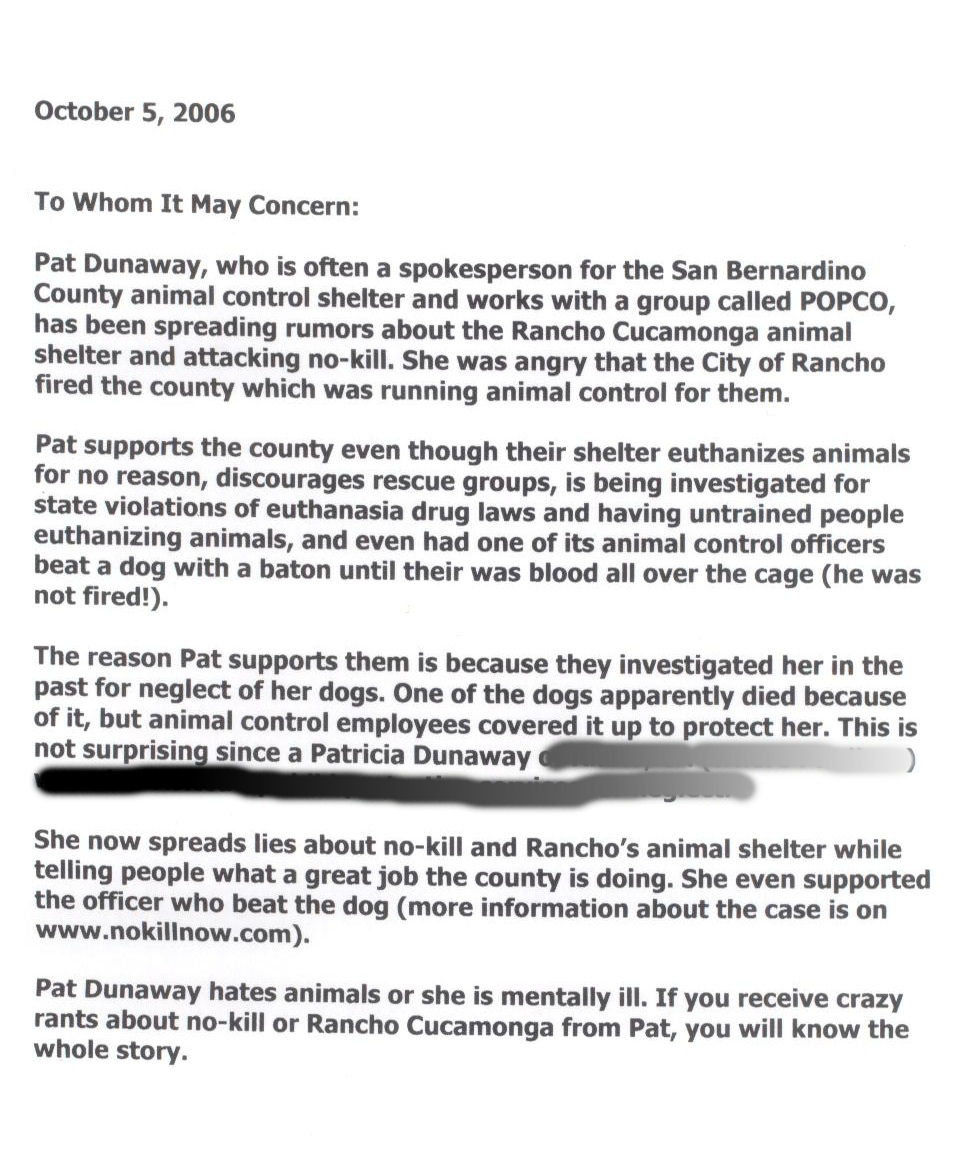
http://www.nathanwinograd.com/linked/dunaway2.jpg
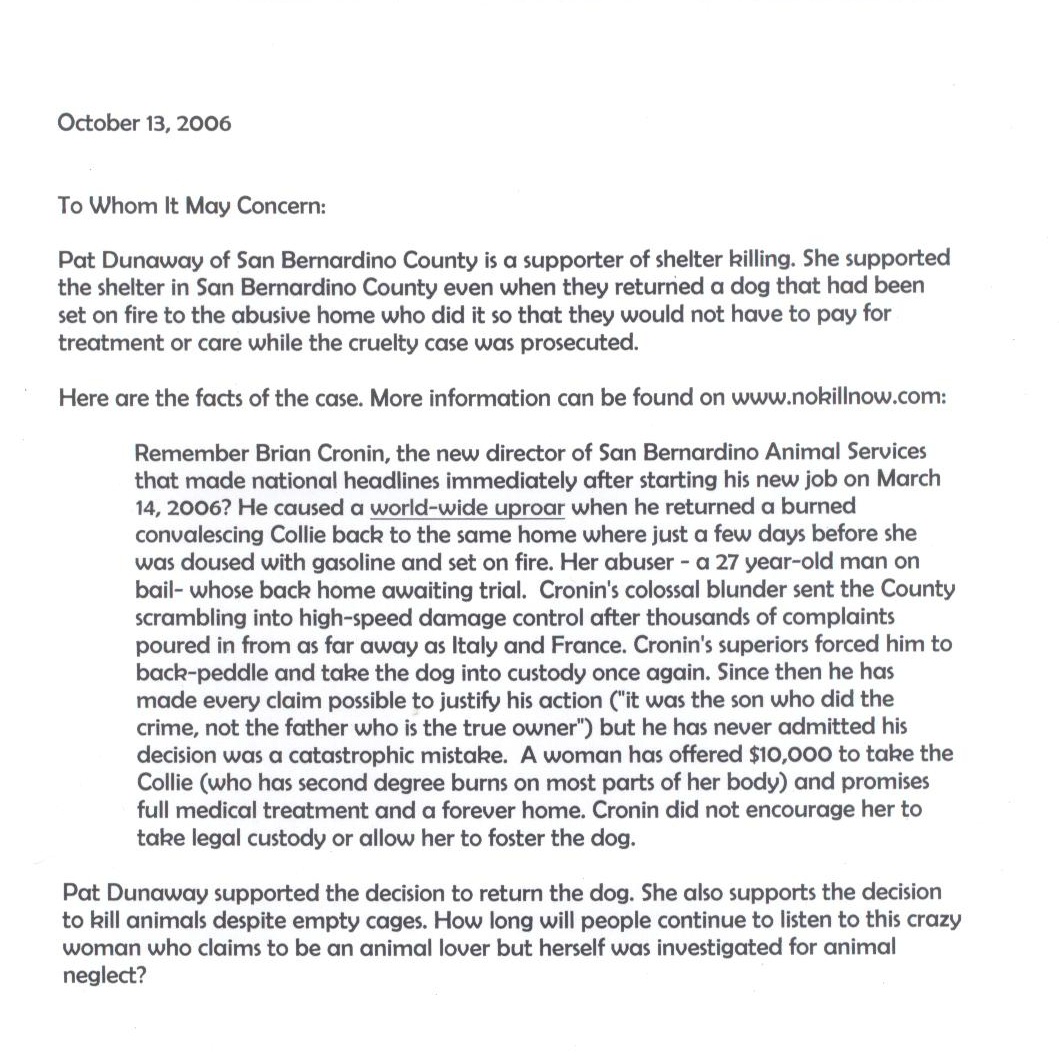
Pat, whether or not you are SON is beside the point. It is obvious from our talks and email that you are an enemy of the entire No-Kill concept, and as such you are getting animals killed. This has to stop.
I have tried to reason with both you and SON about the facts, which neither of you have given me that No-Kill has failed everywhere it has been tried, and that the worst of the No-Kill gurus is Nathan, and everyone, including Boks, Reno, Charlottesville, and Tompkins are just one half step behind.
Your only solution is S/N, but by the stats I just recently posted, LA has been spay neutering ten times as much this decade as the 90s, yet cat impounds have not dropped. This entire decade impounds have remainded flat at around 21,500 per year. Massively increased S/N and City supported TNR has done nothing to bring impounds down.
Why? Because as is pointed out by the commenter below, the S/N efforts have been happening in the areas where the animals are being impounded.
Fantastic Statistical Summary of LAAS 2008 Performance
I thought only Brad Jensen did charts as good and clear as sent out by LAAS and Boks today:
http://www.laanimalservices.com/PDF/reports/annual/2008%20Statistical%20Report%20LA%20Animal%20Services.pdf
I don't have the time to explore all the ramifications of these charts, but Ed does make it clear that the department's spay/neuter programs over the years, as well as those of rescue groups, Maddies, etc., has not help one iota in reducing the impound numbers or rates for cats.
I have long held this view and finally Boks concurs.His solution is to do more of the same with the naive belief that doing more will finally have a positive result.
Rather than draw the conclusion that feral S/N efforts, as well as low/moderate S/N programs for the public have been a failure and other solutions should be looked at, he steps aside and explains the department has not been able to do more because of the environmentalist’s lawsuit and that by the National Audubon Society. If they were not blocking, the City’s S/N efforts, Boks contends doing more of the same will work.
My suspicion is that even if we double the amount of S/N monies and effort, we will not halve the number of cats impounded. There are other factors we do not understand because the Department and Boks have not done enough raw data field analysis, or spent the time conceptualizing why S/N has failed.
I know the same persons will respond--she always does--that stats prove S/N works by citing such and such a study, city or shelter, or years for which we do not have data.
I wish these critics would instead focus on the data presented.
The Department performed 270,000 surgeries either directly or through certificates and mostly spay/neuter from 2001 through 2008 (33,750/year), and cat intake remained fixed throughout this decade at about 21,500. This year we are 1,800 above that, last year about 1,200 below that.
All through the 1990s, the department was responsible for only 36,000 such surgeries, or 3,600/year. We are now doing 10 times as many surgeries with no decrease in cat impounds throughout this decade.
This just stands against common sense and so it is ignored or the usual suspect comes out and says what about….
Yes, but what about Los Angeles? Can you explain why all spay/neuter efforts have failed using a ten fold increase in S/N surgeries over the decade before?
We cannot rely on S/N efforts or even TNR. There is something else going on here such that S/N is failing and no one is getting a conceptual grip on it. They are ignoring the obvious trends.
Here is my suspicion:
The problem is much bugger than anyone realizes. The number of housed and feral cats is much larger than anyone has imagined. Therefore, 37,500 surgeries a year are not nearly enough to do the deed. I think we might have to do 4 to 5 times as many to significantly impact cat intake numbers, not 50% more.
This would require a whole new strategy because we will never reach 150,000 S/N surgeries a year.
Such sterilization rates will only obtain once we have a chemical permanent or vaccine permanent ability to sterilize cats.
There may be a much higher breeding dumping going on than imagined. There may be far more housed cats that do not get sterilized than imagined. The total cat population in the City may be far higher than anyone has conceived.
The only way we'll know is to ignore "experts" estimates, and do a field counting census of housed and ferals, watch a few hundred feral colonies over a period of 2-3 years in various parts of the City, and monitor caretakers known to LAAS as having too many cat complaints for numbers and dynamics.
Rather than LAAS and ACTF take action by busting these individuals, we need to study what is happening and the best was to "suppress" the unwanted cat situation.
I think we will find overburdened caretakers, known to the City as "hoarders," every block or 2. By that, I mean someone with at least 10 indoor and outdoor cats in every block, with a number not being sterilized.
I believe there is a failure to adequately sterilize these animals from fear by the caretaker to come in contact with Animal Services. Instead they hide their situation and need for low cost S/N. This fear is justified based on LAAS's and the ACTF's attitudes towards having "too many cats."
In my mind there is much more going on than even this, but we won't know until we investigate.
http://www.laanimalservices.com/PDF/reports/annual/2008%20Statistical%20Report%20LA%20Animal%20Services.pdf
I don't have the time to explore all the ramifications of these charts, but Ed does make it clear that the department's spay/neuter programs over the years, as well as those of rescue groups, Maddies, etc., has not help one iota in reducing the impound numbers or rates for cats.
I have long held this view and finally Boks concurs.His solution is to do more of the same with the naive belief that doing more will finally have a positive result.
Rather than draw the conclusion that feral S/N efforts, as well as low/moderate S/N programs for the public have been a failure and other solutions should be looked at, he steps aside and explains the department has not been able to do more because of the environmentalist’s lawsuit and that by the National Audubon Society. If they were not blocking, the City’s S/N efforts, Boks contends doing more of the same will work.
My suspicion is that even if we double the amount of S/N monies and effort, we will not halve the number of cats impounded. There are other factors we do not understand because the Department and Boks have not done enough raw data field analysis, or spent the time conceptualizing why S/N has failed.
I know the same persons will respond--she always does--that stats prove S/N works by citing such and such a study, city or shelter, or years for which we do not have data.
I wish these critics would instead focus on the data presented.
The Department performed 270,000 surgeries either directly or through certificates and mostly spay/neuter from 2001 through 2008 (33,750/year), and cat intake remained fixed throughout this decade at about 21,500. This year we are 1,800 above that, last year about 1,200 below that.
All through the 1990s, the department was responsible for only 36,000 such surgeries, or 3,600/year. We are now doing 10 times as many surgeries with no decrease in cat impounds throughout this decade.
This just stands against common sense and so it is ignored or the usual suspect comes out and says what about….
Yes, but what about Los Angeles? Can you explain why all spay/neuter efforts have failed using a ten fold increase in S/N surgeries over the decade before?
We cannot rely on S/N efforts or even TNR. There is something else going on here such that S/N is failing and no one is getting a conceptual grip on it. They are ignoring the obvious trends.
Here is my suspicion:
The problem is much bugger than anyone realizes. The number of housed and feral cats is much larger than anyone has imagined. Therefore, 37,500 surgeries a year are not nearly enough to do the deed. I think we might have to do 4 to 5 times as many to significantly impact cat intake numbers, not 50% more.
This would require a whole new strategy because we will never reach 150,000 S/N surgeries a year.
Such sterilization rates will only obtain once we have a chemical permanent or vaccine permanent ability to sterilize cats.
There may be a much higher breeding dumping going on than imagined. There may be far more housed cats that do not get sterilized than imagined. The total cat population in the City may be far higher than anyone has conceived.
The only way we'll know is to ignore "experts" estimates, and do a field counting census of housed and ferals, watch a few hundred feral colonies over a period of 2-3 years in various parts of the City, and monitor caretakers known to LAAS as having too many cat complaints for numbers and dynamics.
Rather than LAAS and ACTF take action by busting these individuals, we need to study what is happening and the best was to "suppress" the unwanted cat situation.
I think we will find overburdened caretakers, known to the City as "hoarders," every block or 2. By that, I mean someone with at least 10 indoor and outdoor cats in every block, with a number not being sterilized.
I believe there is a failure to adequately sterilize these animals from fear by the caretaker to come in contact with Animal Services. Instead they hide their situation and need for low cost S/N. This fear is justified based on LAAS's and the ACTF's attitudes towards having "too many cats."
In my mind there is much more going on than even this, but we won't know until we investigate.
Subscribe to:
Posts (Atom)